

The first time a six-year-old holds a remote control, he does not steer. He holds the stick down and laughs while the truck slams into the baseboard. That is not a discipline problem and it is not a bad kid. That is a child who has never had to think about a second stick before, and nobody has shown him which one does what.
I learned that on a Tuesday afternoon in October, on the braided rug in my living room, with my grandson Wyatt. He is six, in first grade, and he has never read an instruction guide on purpose in his life. Before the Monster Jam Grave Digger showed up, we had tried a hand-me-down RC car a neighbor passed along. One wheel on the controller, hard plastic tires, and a steering trim nobody had ever set right. Wyatt spun that thing in circles for twenty minutes, could not make it go where he wanted, and put it in the toy box. I found it in the spring with the batteries still inside. So this time I did not hand over the box and walk away. I broke it into five steps and spread them over about a week.
The truck that survived the rug, the kitchen floor, and the yard
The 1:24 scale Grave Digger comes with the truck, the dual-joystick controller, and an instruction guide. You supply five AAA batteries. That is the whole list. A six-year-old can handle it, which is the point.
Amazon Check today's price on Amazon →Step 1: Get the batteries in before the kid sees the box
The fastest way to ruin a first impression is to make a child wait while you hunt for a screwdriver. The Grave Digger RC needs five AAA batteries, and the listing does not say that loudly enough for anybody skimming a phone at ten o'clock at night. The first time, I opened the box right there on the kitchen table with Wyatt standing over me, and it took eleven minutes of him asking whether it was ready yet. Eleven minutes is a long time to a six-year-old. The second time, I put the batteries in the night before and had the truck sitting on the counter like it had always lived there.
I am not going to tell you how many go in the truck and how many go in the controller, because I got that wrong the first time and had to go back to the guide. Five AAA total is the number that matters. Buy them in a big pack. Cheap batteries make a slow truck, and a slow truck is a boring truck to a kid this age. The truck itself weighs about a pound and is eight inches long, so it is not a heavy machine and it does not need much. It just needs fresh.
The other thing I did was keep the instruction guide. Not for him. For me. I read it once on the couch on a Saturday night, then put it in the drawer under the phone where I keep the takeout menus. There were questions later, mostly about why the Monster Jam truck pulled to one side on the kitchen floor, and I did not want to be guessing at the answer in front of a child who believes I know everything.
Step 2: Teach the sticks one at a time, not together
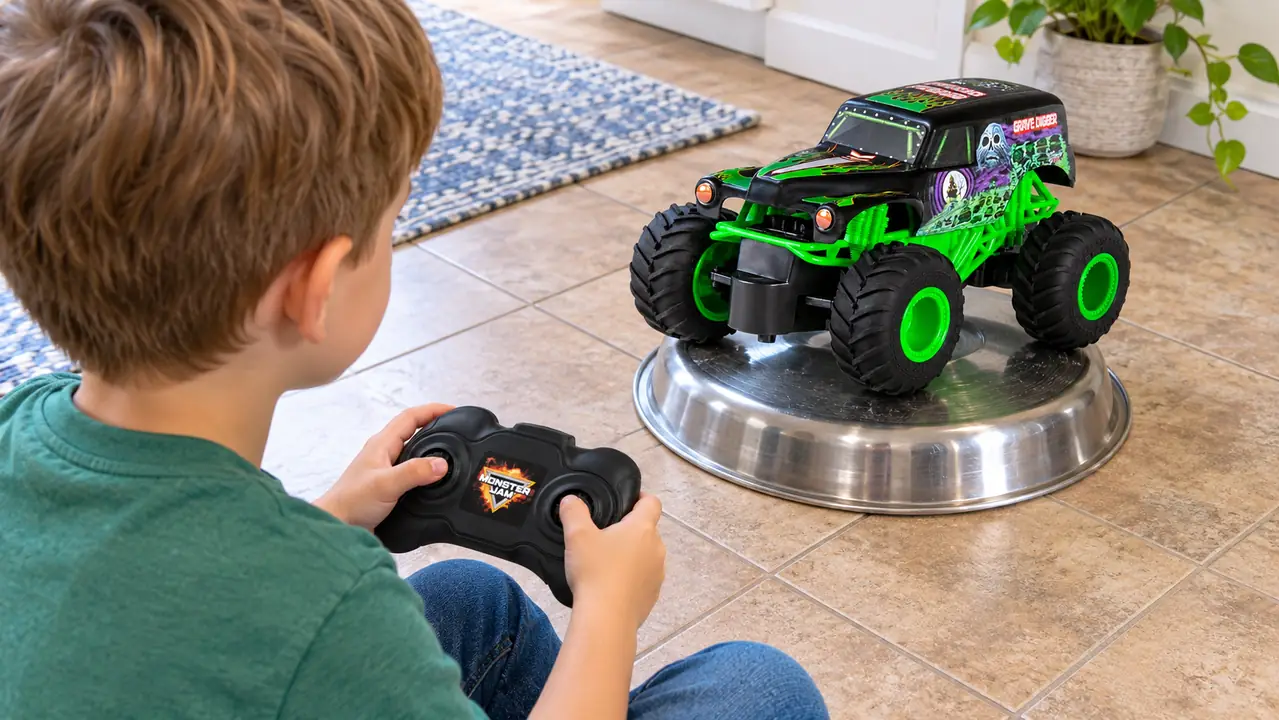
This is the step most parents skip, and it is the one that matters most. The Grave Digger controller is a dual-joystick design, and two sticks is one more stick than a six-year-old's hands and brain want to manage at the same time. If you tell him this one drives and this one steers, you get a kid mashing both and a truck doing doughnuts under the coffee table while he laughs and you start reading the return policy.
So we did one stick per session. The first day I put my hand flat over the steering stick and let him work the throttle only. Straight lines, back and forth across the rug. He drove into the couch four times, into my foot twice, and into the leg of the coffee table once. He thought every single one was hilarious. But by the end of fifteen minutes he had worked out that the stick in his right hand made the truck move, and that is the foundation for everything that comes after it.
The next session I flipped it. I handled the throttle and let him steer. He got to feel what turning does without also having to think about speed, and the truck went in slow, wide, wobbly arcs around my chair while he leaned his whole body the way he wanted the truck to go. By the third session he was doing both, badly. Badly is exactly where a six-year-old should be at that point. I would rather have a kid driving badly on his own than driving well because I am hovering over his shoulder the whole time.
He drove into the couch four times, into my foot twice, and into the leg of the coffee table once. He thought every single one was hilarious. But he learned which stick made the truck move.
Step 3: Give him a small, boring space where nothing can break
The living room rug is not a driving course, and the backyard is a driving course. But you cannot start in the backyard. The backyard is huge and full of distractions, and a six-year-old on his first real drive will hold the throttle down and chase the fence until the truck is out of sight and he is out of breath and you are both done for the day.
We started on the rug with the coffee table pushed flat against the wall. That left a space about six feet by eight feet, which I paced off with my own feet because I wanted to know. Small enough that he hit a boundary constantly and had to learn to correct. Boring enough that the truck had nowhere to run to. I moved everything breakable off the low shelf first, which turned out to be smart, because the truck found that low shelf twice in the first ten minutes and both times a plastic picture frame took the hit.
Once he could do a full lap of that little space without flipping the truck over, we moved to the kitchen floor. Hard floor, more speed, more slide, and a laundry basket dragged over to act as a wall. Then, after about four days of short sessions, we went outside. Four days is not a schedule anybody has to keep. It is just how long it took a busy six-year-old to get tired of crashing on purpose and start wanting to actually drive the thing.
Step 4: Build a course in the yard before you turn him loose
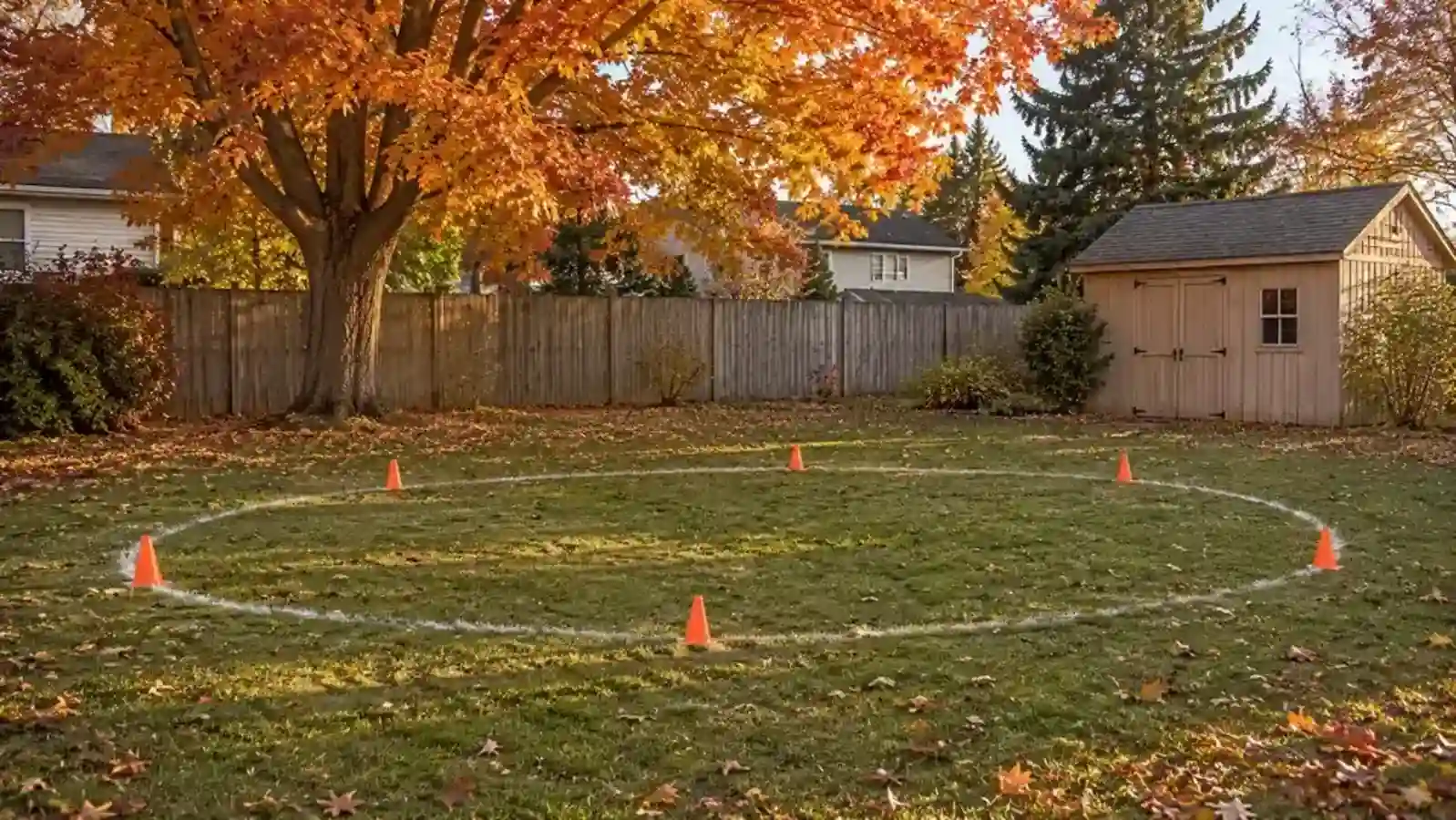
An empty backyard is a trap. The kid drives in a straight line, the truck gets a hundred feet away, he cannot tell which end is the front anymore, and then he loses interest and asks for a snack. The fix costs about as much as a bag of oranges. Give the space edges and give him something to go around.
I raked the maple leaves to the sides of the yard and set out six small orange cones in a rough oval, maybe twenty feet long and twelve feet wide. That is it. Six cones. He had to drive around them, which meant he had to steer while the truck was moving, which is the entire skill in one sentence. It also kept the truck close enough that I could see it from the porch steps with a cup of coffee, and close enough that he could see it.
The controller runs on 2.4 GHz and the range is more than a kid needs in a backyard. I would just as soon he not use all of it. Keeping him in a space he can see is a habit worth building early, because the day the truck disappears behind the shed is the day he learns to walk after it, and then you are teaching a different lesson than the one you planned.
Step 5: Let him crash it, then let him check it
The Monster Jam Grave Digger is built for stunts and crashes. That is not sales talk, that is the design, and a one-pound truck at kid speed hitting a plastic cone is not a crisis. The hard part was me. I had to stop myself from saying careful every thirty seconds, because every time I said it, Wyatt slowed to a crawl and got that flat look that means he is about to go find something else to do.
What I did instead was teach him to check the truck whenever it stopped. Wheels still on? Battery door still shut? Nothing wound around an axle? He is six, so this turned into a little ritual, and honestly he liked the checking as much as the driving. He would pick it up, turn it over in his hands, look at all four wheels, and announce that it was fine. That is a good habit for a kid who is hard on toys.
There is no warranty on this truck, according to the manufacturer's description, so a kid who learns to pick it up and look it over is a kid who is going to have it longer. That is not a reason to avoid the toy. It is a reason to spend ten minutes teaching him how it works before he starts asking it to do things it was never built to do.
What Else Helps
Three small things made the week easier. The first was a plastic tub with a lid, kept on the shelf by the back door. The truck goes in the tub, the controller goes on top of the truck, the lid goes on. When a toy has a home, cleanup stops being a negotiation. It also means the controller does not end up between the couch cushions, which is exactly where the hand-me-down car's controller lived until we gave up looking for it.
The second was a kitchen timer. Fifteen minutes of driving, then a break whether he wanted one or not. A six-year-old will not stop on his own. A tired kid who keeps crashing gets frustrated, and a frustrated kid does not say he is tired, he says the toy is boring. Short sessions kept the truck feeling like a treat instead of a chore, and they kept me from having to referee a meltdown at four in the afternoon.
The third was letting him show somebody. His teacher, the neighbor across the street, anybody who would stand still for two minutes. Explaining which stick does what to another person is the fastest way to actually learn it, and it gave him a reason to care about getting good at it. The first week he was proud of the truck. By the second week he was proud of himself, which is a different and better thing.
Five AAA batteries, six cones, and about a week of short sessions
That is the whole investment in turning a six-year-old into somebody who can actually drive. The Monster Jam Grave Digger arrives with the truck, the dual-joystick controller, and the instruction guide. Everything else is a trip to the hardware store and some patience on the porch.
Amazon See today's price on Amazon →