
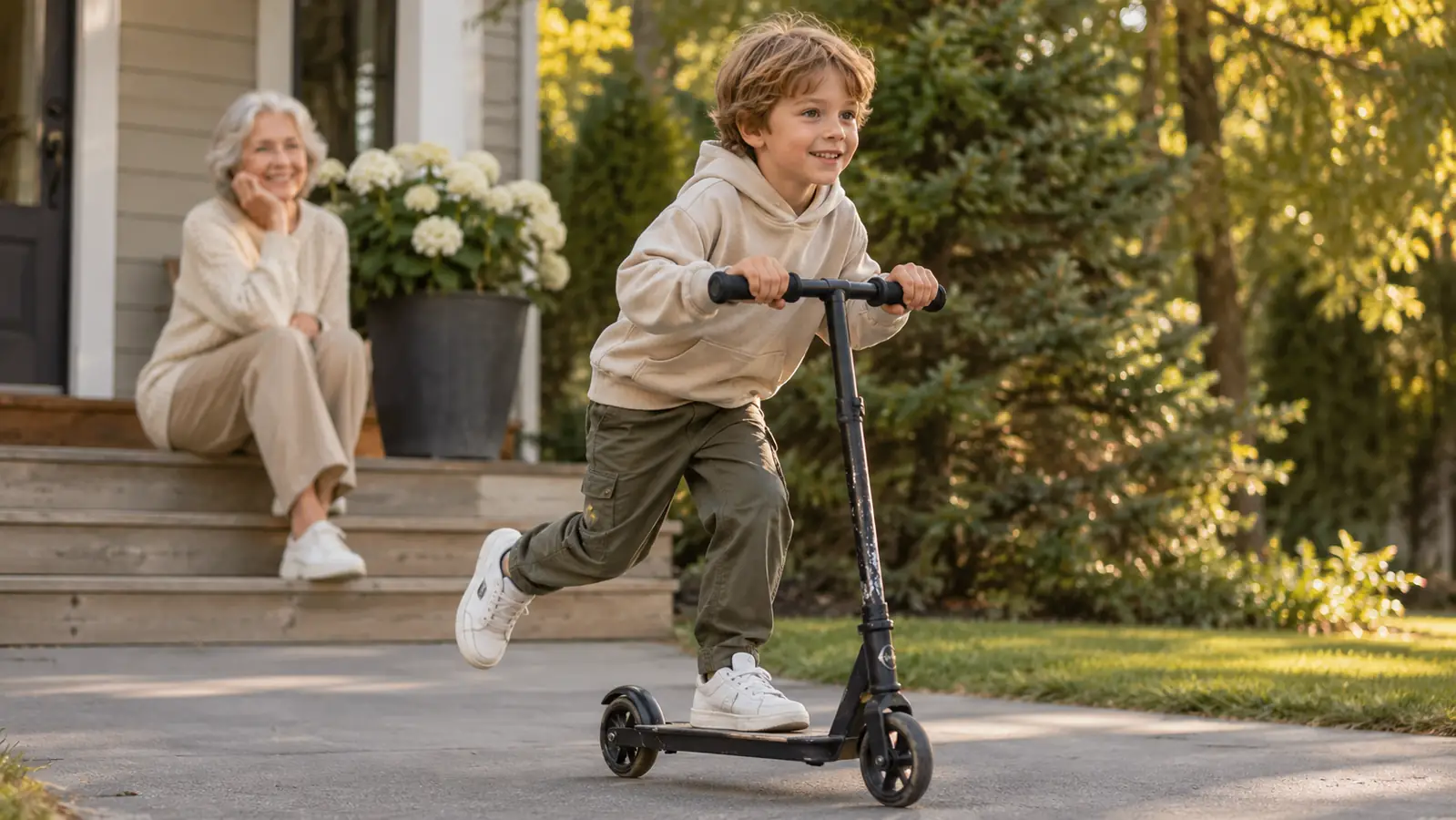
Wyatt turned six in March. By the middle of April he had decided that riding a scooter was the single most important skill a person could have, because the two boys across the street had one and they looked, in his words, like they were flying.
I am seventy-one years old and I have bought a great many toys in my life, most of them forgotten by Tuesday. So I did what I always do now. I waited. I watched. I let him ride the neighbors scooters for two weeks before I ordered the Razor A Kick Scooter, and I told myself that if he asked about it every single day in that stretch, I would buy it. He asked nine days out of fourteen. Close enough. That was in late April. This is what I have learned since, and it is not all good news, because nothing with a six-year-old ever is.
The Quick Verdict
A light, foldable, genuinely durable scooter that a six-year-old can pick up and carry himself. The learning curve is steeper than the three-wheel version, and the first two weeks cost us a few scrapes. Worth it, with supervision.
Amazon Check Today's Price →The scooter Wyatt still reaches for four months later
Aluminum frame, folding mechanism, adjustable handlebars up to 36 inches. It weighs 4.6 pounds, which means a first grader can carry it up the porch steps without help.
Amazon Check Today's Price on Amazon →How I've Used It
We started in the driveway on a Saturday morning, which is flat concrete with a slight slope toward the street. That slope scared me more than it scared him. I made him wear the helmet and I walked beside him with one hand hovering behind his back for the first three days, which he tolerated and then loudly did not tolerate. The driveway is twenty-two feet from the garage door to the sidewalk. I know that because I paced it out that first morning, trying to decide whether it was long enough to be worth the trouble. It was.
The Razor A is a two-wheel scooter, and that matters more than I understood when I ordered it. The neighbor boys ride the same setup, so Wyatt wanted to match them, but two wheels require balance in a way that three wheels do not. The first week he fell four times. None of the falls were bad. All of them were on the grass, because I steered him there, and every one of them was followed by him standing up, announcing he was fine in a voice loud enough for the whole street, and getting back on. By the end of the second week he could push, glide, and stop without putting a foot down. By the end of the third he was doing laps around the maple tree in the backyard, and I had moved my folding chair to the middle of the yard so I could see both the tree and the gate at the same time.
The stopping is the part I want to talk about, because it is the part that made me nervous. There is a rear-fender brake. You press down on the back fender with your heel and it drags against the rear wheel. It works, and it works well once a child has the coordination to press and hold rather than stab at it. Wyatt stabbed at it for about ten days. I stood in the driveway hollering press and hold more times than I can count, and my neighbor Linda across the street started finishing the sentence for me. Now he does it without thinking. I can hear the difference from the kitchen: a long even scrape instead of a short tap, and then quiet.
By June the scooter had a place by the porch door and a routine to go with it. He rides after breakfast, before the heat gets bad, and again after supper if the light holds. I have gotten into the habit of taking my coffee out to the porch steps at seven-thirty and watching him do laps. There is a rhythm to it I did not expect. Push, push, glide, coast, drag the heel, turn around, start over. Some mornings he narrates the whole thing to himself in a voice I cannot quite hear from where I sit, and I have learned not to ask what he is saying, because asking stops it.
What the Folding Mechanism Is Actually Good For
I did not expect to care about the folding mechanism. I expected it to be a line on the box. I was wrong, and I will tell you why.
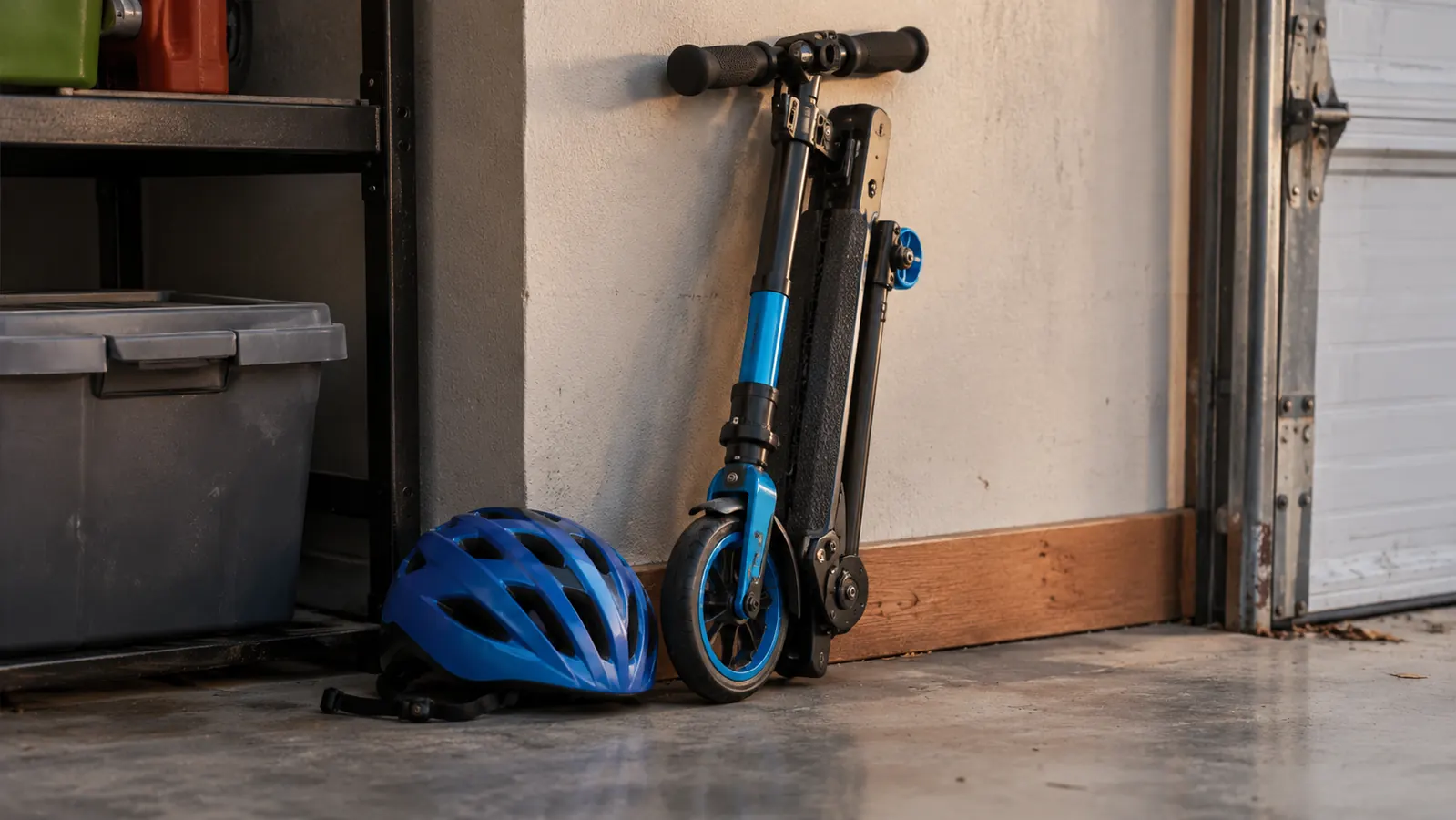
A 4.6 pound scooter sounds light, and it is, but a six-year-old carrying a scooter by the handlebars while walking up porch steps is a six-year-old with a scooter swinging into his shins. He did that exactly twice before I got tired of it. The fold is one motion, a lever at the base of the stem, and it collapses the whole thing down flat. Wyatt learned it in an afternoon and now folds it himself before he comes inside, because I told him that a scooter left standing in the hallway is a scooter I will trip over at six in the morning.
The listing gives the dimensions as 24 inches long, 11.25 inches wide, and 32.5 inches high. Folded, it slides under the bench on the porch with room to spare. It also fits in the trunk of my car without any arranging, which I have now tested twice. Both times we drove to the church parking lot on a Saturday morning, because the asphalt there is smooth and empty and there is a curb I can sit on with my back against the sign post. That is the whole use case for folding, and it turns out that is enough.
The aluminum frame is the other thing I will vouch for. Four months of a boy who is hard on everything, and the frame has no dents, no bends, and no rust at the joints. The foam grips are scuffed where his palms land but they have not torn or come loose. The urethane wheels show wear, because they should by now, but they have not flat-spotted and they have not chunked.
The Handlebar Height Question
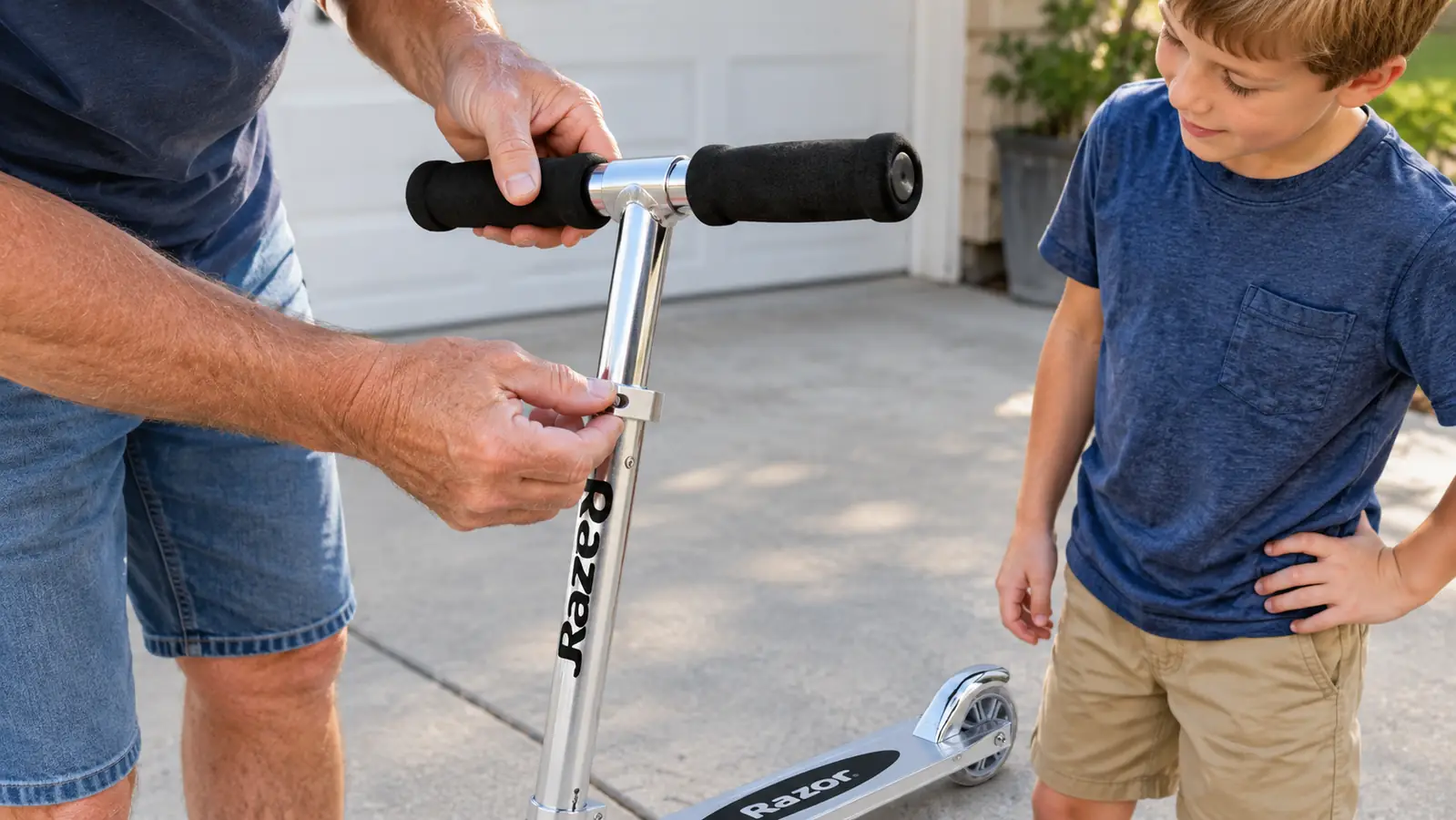
The handlebars adjust, and the handle height tops out at 36 inches. When the scooter arrived it was set near the bottom, and Wyatt rode it that way for about six weeks before I noticed he was hunched over it like a question mark. I had been watching him ride. I had just been watching his feet, not his shoulders. That was my mistake and it took me a while to see it.
I raised it two notches. He stood up straight and immediately rode better, which should have been obvious to me and was not. The lesson I would pass along is to check the height every few weeks, not once at the start. Children at six grow in unpredictable little bursts, and a scooter he has to crouch on is a scooter he will abandon without ever being able to explain why. I keep a pencil mark on the door frame by the kitchen where we measure him. He has gone up an inch and a quarter since March.
Four months of a boy who is hard on everything, and the frame has no dents, no bends, and no rust at the joints.
The 143 pound weight capacity is generous for a first grader and means this scooter will follow him for years. That is either a comfort or a warning, depending on how much room you have in your garage.
Where It Frustrated Us Both
Two things, and the first is the learning curve. I want to be honest about that because the listing photographs make it look effortless. A two-wheel scooter is not effortless for a six-year-old. It took us two weeks of daily practice to get to a point where I was not standing in the driveway with my heart in my throat. There was one afternoon in the first week when he fell, sat down in the grass, and told me he was never riding it again. I did not argue with him. I brought out a glass of water, sat down in the grass beside him, and waited. He was back on it twelve minutes later. If your child is timid, or if you cannot stand out there every day for a while, that is a real consideration and you should weigh it.
The second is the surface. This scooter wants smooth pavement. On our driveway and on the church lot it glides beautifully. On the cracked sidewalk at the end of the street, where the roots of the old oak have pushed the slabs up into little ridges, it rattles so hard that Wyatt slows to a crawl and eventually gets off and walks. The specs list a rear suspension, and it does take some of the edge off, but it does not turn a bad sidewalk into a good one. If your neighborhood looks like the corner of our street, expect to load it in the car and drive somewhere smoother.
Who This Is For
This is for a child around six or older who already has decent balance on a bike or on a three-wheel scooter and who wants to keep up with other kids on two wheels. Wyatt was ready. The neighbor boy who is four and a half is not. I watched him try it once, get frustrated, and go back to his three-wheel version, and that was the right call for now.
It is also for a grandparent or a parent who wants something light enough to move around without a production. I can pick it up with one hand. I can fold it and put it in the car. I do not need Wyatt to help me, and at my age that matters more than it used to.
Who Should Skip It
Skip it if your child is four or five and has never ridden anything with two wheels. The three-wheel version exists for a reason, and starting here just means more falls and more frustration for everybody involved.
Skip it too if your only riding surface is a cracked sidewalk or a gravel driveway. This scooter is a pavement tool, and on anything else it is a bumpy, unpleasant ride and your child will not thank you for it. And skip it if you are not going to be outside with them for the first couple of weeks. A two-wheel scooter is safe once a child can ride it. Before that, it needs eyes on it, and eyes that belong to an adult, not to a neighbor kid who is nine and has his own ideas.
What I Liked
- Light enough for a six-year-old to carry and for a grandmother to lift with one hand
- Folds flat in one motion, which made it genuinely portable rather than theoretically portable
- Aluminum frame has held up through four months of hard use with no dents, bends, or rust
- Adjustable handlebars top out at 36 inches, so it grows with the child
- Rear-fender brake works well once a child learns to press and hold
- Solid wheels mean no flat tires, ever
Where It Falls Short
- Two-wheel balance is a real learning curve for a six-year-old, roughly two weeks of daily practice
- Rattles badly on cracked or rough pavement
- The rear-fender brake takes coordination a younger child will not have at first
- Foam grips scuff quickly, though they have not torn
The Small Things Nobody Mentions
The wheels are solid rather than pneumatic, which means no flat tires ever, and that alone is worth something to me. I have pumped up enough bicycle tires in my life to last me. They measure 9.8 centimeters, they are urethane, and after four months they show scuffing but no chunking and no soft spots.
It comes with the scooter and an owner's manual, and that is the whole list. There is no assembly beyond what is already attached, no bag of bolts, no tool I had to go find in the shed. I had it out of the box and standing in the hallway in under five minutes, and I am not a person who is good with that sort of thing. My late husband was the one who put things together in this house. I have gotten better at it out of necessity.
The standing platform sits low enough that Wyatt's size four sneakers fit on it comfortably, but not so low that it scrapes on the driveway when he leans into a turn. He has not caught a toe yet. I keep waiting.
And I will say the thing I always say, which is that the box is the least interesting part and the fourth month is the one that tells you the truth. Four months in, Wyatt rode it yesterday for forty minutes without being asked, up and down the driveway, while I shelled peas on the porch steps. He has other toys out there that have not moved since June. This one moves. That is the only test I have ever trusted, and the Razor A passed it.
Four months in, this is still the one he reaches for
Nearly 34,000 ratings and 4.8 stars, and I can tell you why after living with it. The Razor A holds up, folds flat, and adjusts as he grows.
Amazon Check Today's Price on Amazon →