
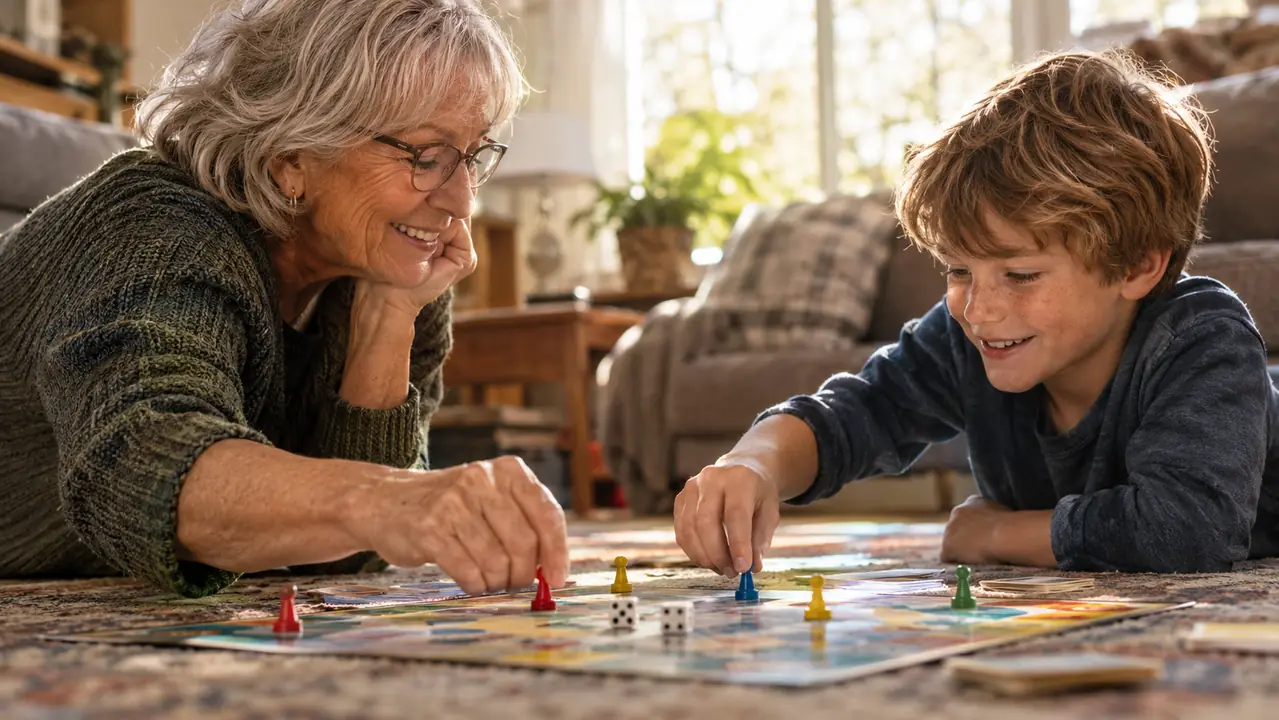
The Connect 4 from Hasbro Gaming has been on my living room rug, off and on, for the better part of a year now. I did not expect that. I have a closet shelf full of things that got played with twice and then retired quietly, and I assumed this would join them by the end of the second week. Wyatt was six when it came into the house, in first grade, and he is the kind of boy who is hard on a toy and quick to lose interest once something stops being new.
What I wanted was not a big production. I wanted something the two of us could sit down with for fifteen minutes before supper. Something he could also play with a friend his own age without me sitting there walking them through the rules every time. And something that would survive being dropped on a hardwood floor, because it would be. We had already been through a puzzle that lost three pieces in a month and a building kit with instructions so fussy that I did the building while he wandered off to the window. The Connect 4 has done the job better than either of those. It has two faults and I will get to both.
The Quick Verdict
Simple enough for a six-year-old to run by himself, sturdy enough to survive him, and the four blue blocker discs keep it from going stale. The slider bar is stiff on a new set and needs an adult hand for the first week.
Amazon Check Today's Price →The one toy from last winter he still asks for
Two players, ages six and up. The box holds the grid, two feet, the slider bar, 42 discs and four blue blockers. Ours has taken a year of hard play and nothing has cracked.
Amazon Check Today's Price on Amazon →How I've Used It
The first month it came out every day after school. Wyatt would drop his backpack by the door, drag the grid to the middle of the rug, and start setting discs out before he had his shoes off. I would sit on the floor across from him, which at seventy-one is not as easy as it used to be, and we would play three or four rounds. Then some weeks it went back in the closet and I did not see it at all. A rainy Saturday would come along and out it would come again, and he would pick up exactly where he left off. That on and off pattern is the one I trust. A toy that only gets played with in the first week is a toy that fooled me, and I have been fooled plenty.
The setup is the part I appreciate most. Everything clicks together in a few seconds. The grid is one piece, the two feet press onto the bottom, and the slider bar runs across the middle to hold the discs up until the round is over. Wyatt does all of it himself now and has since about the third week. There is nothing to read, nothing to plug in, and nothing to adjust. He opens the box, builds the board, and we are playing. For a boy who gets frustrated when instructions are too fiddly, that matters more than any feature printed on the box.
The listing gives an estimated playing time of thirty minutes. Our games run ten to fifteen. That suits us. A six-year-old's attention is a real thing you have to work around, and a game that ends while he still wants another round is better than one that drags on until he is squirming in my lap.
What Comes in the Box
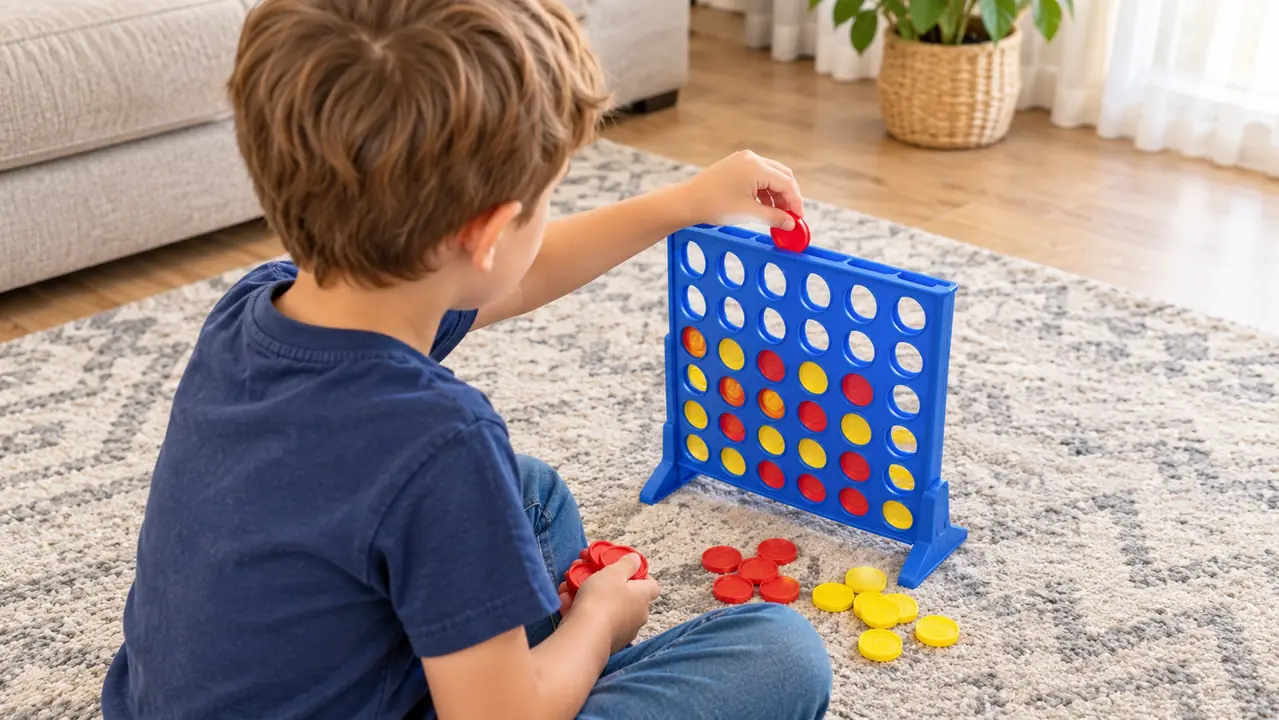
The box from Hasbro Gaming holds the grid, the two feet, the slider bar, 21 red discs and 21 yellow discs. It also holds four blue blocker discs, which is the single reason I would buy this version and not an older one off a yard sale table. The whole set weighs sixteen ounces, so a child can haul it from the living room to the kitchen table without asking for help. Two players, ages six and up. That is on the listing and it is accurate on both counts.
The 42 discs are the whole set, 21 for each player, with nothing left over. That means a lost disc is gone for good, which I learned the hard way. We are down one yellow disc. It went under the stove during a round he was losing badly and it has not come back. The game still plays fine with what is left, because a round almost never fills every hole, but I would not lose many more.
The Blue Blocker Discs Are Why This Version Is Worth It
Here is what the blue discs do. They block. You drop one into the grid to jam up a column your opponent is building, and because a blocker sits in the stack it lifts the discs above it higher than they would otherwise sit. Four of them come in the box. The first time I read that on the listing I thought it was a marketing addition, the kind of thing a company bolts onto an old game to sell you a new box of it. I was wrong about that one.
What the blockers actually did was slow Wyatt down. Plain Connect 4 with a six-year-old is often a race. He builds a column, I build a column, and the whole round is decided by who notices the slant first. Put a blocker in his way and he has to stop and think about whether the spot he wants will still be there after I use one. He started asking questions out loud. Is that one of yours. Can I move it. What happens if I go around instead. Those questions are the whole point. That is a child learning to look two moves ahead, and he got there because the board stopped being simple on him.
Eleven months in, the only thing we have lost is one yellow disc, and that one went under the stove during a round he was losing badly.
He uses the blockers more than I do now. His favorite move is to drop one into a column I have been quietly working, then sit back and grin at me. I let him have it. He is six. There will be years later for me to be ruthless.
What Eleven Months of Play Did to It
Toys in this house get dropped, stepped on, sat on, and once, memorably, used as a ramp for a toy truck. The Connect 4 has come through all of it. The grid has no cracks in it. The feet still press on snugly enough that the board does not wobble when he leans his elbows on it. The discs are all still round and the edges have not chewed up. I cannot say the same for the building kit, which lost a corner in the first month and never recovered.
The slider bar was stiff when it was new. For the first week or two I had to work it with two hands, and Wyatt could not budge it at all, which meant every round ended with him sliding the whole board over to me. That worked itself out. By the end of the second week it moved freely and he has run it himself ever since. It is a small thing and it fixed itself, but if you are giving this to a child who gives up easily, know that the first few days will need an adult hand on the bar.
What Happens When a Friend Comes Over
A boy from his class came over on a Saturday in the spring and they played four rounds in a row without me. That was the test I cared about most, because it is one thing for Wyatt to play with me, where I can nudge him along, and another for two six-year-olds to manage it alone. They managed it. The only argument was about who got to use the blockers first, which is not the game's fault.
The rules are simple enough that they settled it themselves in about a minute. Get four in a row and you win. Do not knock the board over. Use a blocker if you have one and it helps you. That is the entire rulebook as far as a six-year-old is concerned, and it meant I could sit in the kitchen with my coffee and listen to them instead of refereeing.
Where It Gets Under My Skin
The game has one real weakness with a child this age and it is the checking. Four in a row can run across, up and down, or on a slant, and a six-year-old will see the flat row in front of his nose and miss the diagonal every time. Sometimes he misses mine. That means I have to decide, every single round, whether to point it out or let it stand. That is not the game's fault exactly, but it does mean an adult is needed at the table at six, and it is not something you can hand two kids and walk away from for an hour.
It is also strictly a two-player game. That is on the listing and it is honest. If your child is an only child, or the other children in the house are too young or too old to be a fair match, this needs a partner, and that partner is going to be you more often than not. I do not mind it. But I would not buy it thinking it will occupy him alone on a wet afternoon.
What We Compared It To
We have Jenga in the house too, from the same side of the closet. For us the comparison is not close. Jenga is you against a wobbling tower, it is over fast, and it usually ends with a crash that Wyatt finds hilarious and I find loud. The Connect 4 from Hasbro Gaming has another person inside it. The whole game is reading what somebody else is doing and deciding what to do about it. For a boy who likes to win and is still learning how to lose without a fuss, a real opponent is more useful practice.
We tried a couple of card games in the same stretch and neither one held. Too much shuffling, too many rules I had to keep re-reading at the table. The Connect 4 has one rule. Get four in a row. Everything else is thinking, and thinking is the part I want him doing.
What I Liked
- One rule to learn, so a six-year-old can run the whole game himself after a week
- The four blue blocker discs add real thinking and keep the rounds from going stale
- Sets up in seconds and comes apart just as fast, with nothing to plug in or adjust
- Nothing has cracked, chipped or wobbled in eleven months of hard play
- Sixteen ounces, so a child can carry it from room to room
- Rounds run ten to fifteen minutes, which fits a short attention span
Where It Falls Short
- The slider bar is stiff for the first week and a small child needs help with it
- Two players only, so an only child needs an adult or a friend at the table
- An adult has to referee the diagonals at six or the games go wrong
- No spare discs in the box, so a lost disc is gone for good
Who This Is For
This is for a grandparent or a parent who wants fifteen quiet minutes at the end of the day with a child who is six or seven. It is for a child who likes to win and needs practice at losing, because the rounds are short enough that a loss does not ruin the whole afternoon. It is for a house where the tablet has gotten a little too comfortable on the couch. And it is for anyone who wants a game a child can set up, run and put away by himself, because that independence turns out to be worth as much as the game.
Who Should Skip It
Skip it if the child is under six. The pieces are not a hazard, but the thinking is not there yet and the losses land hard. Skip it if you need something a child can play alone, because it will not do that. Skip it if the child in question wants action, noise and moving parts, since this is a sit-still game and no number of blue discs changes that. And skip it if you were hoping to keep three or four children busy at once. This is two players, and it means it.
If you want the one that is still on the rug in month eleven
The grid, two feet, the slider bar, 42 discs and four blockers. Ages six and up, two players, ten minutes a round. It replaced nothing in our house and got played with anyway.
Amazon Check Today's Price on Amazon →