
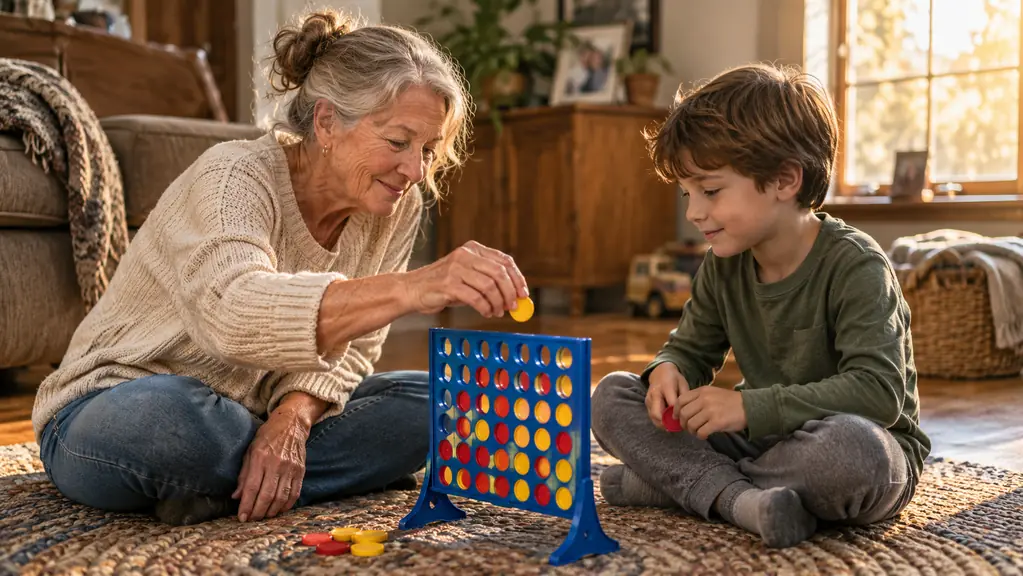
Wyatt is six, in first grade, and he loses interest in a game faster than any child I have ever met. He is also hard on toys. So when I went looking for one game worth keeping on the living room shelf, I did not test anything for an hour and call it done. I put two games on the rug and left them there for five weeks. One was the Hasbro Gaming Connect 4, the Amazon exclusive version with the blue blocker discs. The other was a plain set of Jenga blocks a neighbor handed me in a paper sack. As of this week, one game is still sitting by the couch. The other is in the toy bin under the stairs, and I can tell you exactly why.
If you want the short answer, here it is. For a six-year-old who gets frustrated when a game asks too much of his hands, the Hasbro Gaming Connect 4 is the better pick. It sets up in about a minute, the rule fits in one sentence, and every round ends with a full board and a clear winner. Jenga is a good game and I am not going to pretend otherwise. But Jenga asks a child to slow down and be careful, and that is a hard sell for a boy who is loud and in a hurry. Connect 4 asks him to think one move ahead, which he will do without ever noticing he is doing it.
Side by Side: Connect 4 and Jenga
| Connect 4 (Hasbro Gaming) | Jenga | |
|---|---|---|
| Setup | Grid, two feet and a slider bar, about a minute | Dump the blocks and stack a tower, several minutes with a steady hand |
| Rule a six-year-old must hold in his head | Drop a disc, get four in a row | Pull a block, stack it on top, do not knock the tower down |
| Length of one round | A few minutes, and the board tells you when it is done | Can end in ten seconds or drag on for twenty minutes |
| What it rewards | Looking a move ahead | A steady hand and steady nerves |
| Holding a fidgety kid | He has to sit and watch the board | He leans in, holds his breath and stays put |
| Noise and mess | Discs end up under the couch and the slider bar clatters | One loud crash, then it is over and contained |
| Durability | Plastic grid and discs, 16 ounces, wiped clean with a damp cloth | Wooden blocks chip, swell and get sticky with juice |
| More than one child at the table | Two players | As many as you can fit around the table |
| Storage | Grid, two feet, slider bar and 46 discs back in one box | Blocks back into a cardboard sleeve |
| Best for | One child and one adult, played over and over | A table full of kids and a loud evening |
Where Connect 4 Wins
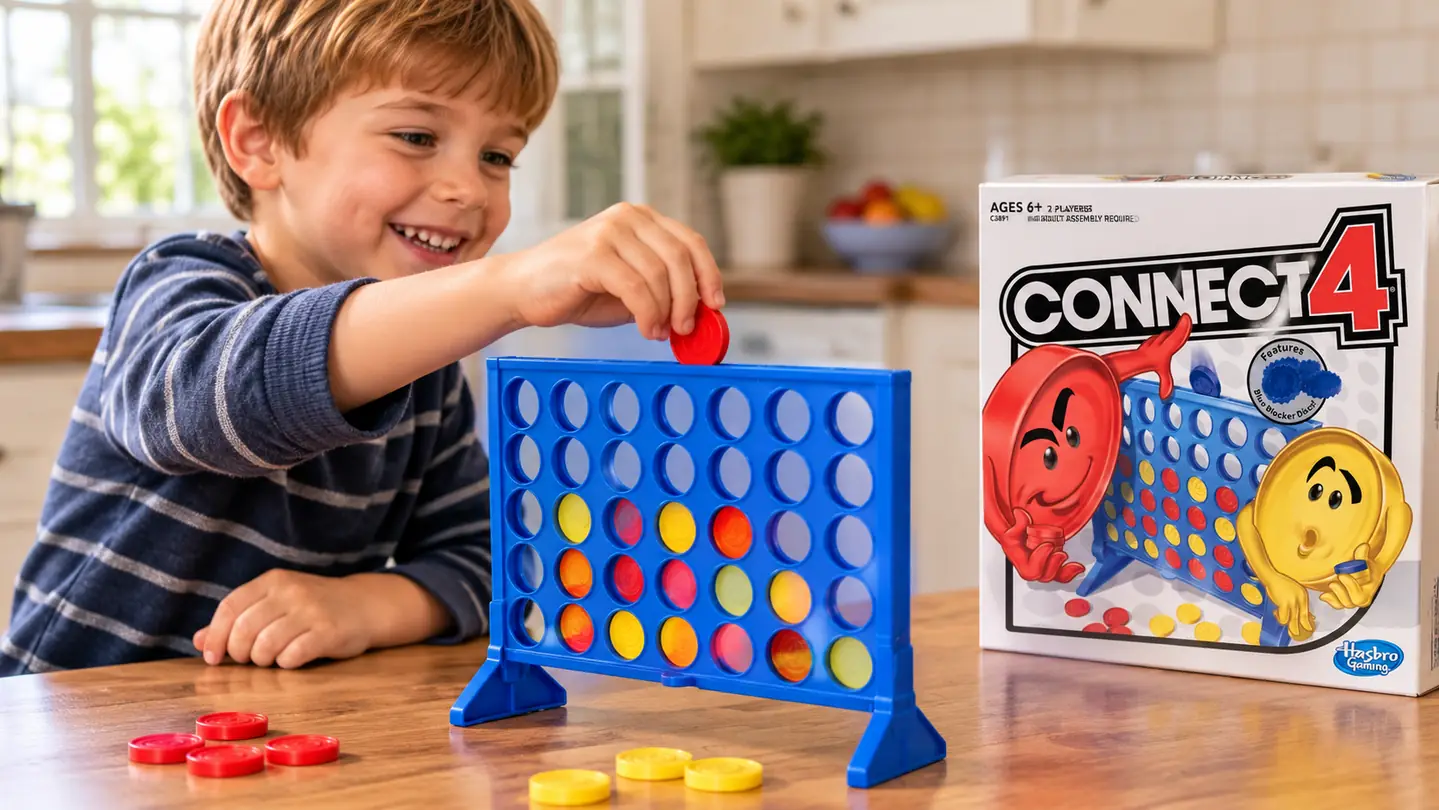
The first win is the rule. You drop a disc, you try to get four in a row, and that is the whole game. The Hasbro Gaming set comes with a grid, two feet, a slider bar, twenty-one red discs, twenty-one yellow discs and four blocker discs. It is built for two players, ages six and up, and the box estimates thirty minutes of play. In our house a single round runs closer to five. That is not a complaint. A short round means Wyatt can lose one, ask for another, and still be in bed on time.
The second win is that it teaches a child to look ahead without announcing that it is teaching him anything. Somewhere in the third week I watched him stop dropping discs in the middle and start working the far right column, because he had noticed that I kept filling it. He did not say the word plan. He just did it. That is the thing a first game is supposed to do, and Connect 4 does it with a board simple enough that a six-year-old can hold the whole picture in his head at once.
The third win is that it survives. The whole set weighs sixteen ounces and everything is plastic, so a disc that slides under the couch can be found, wiped off and used again. We have lost two discs in five weeks. The game still works. With a wooden block game, a chewed corner or a block left out on the porch overnight is a permanent problem, and you cannot replace half a tower.
Where Jenga Wins
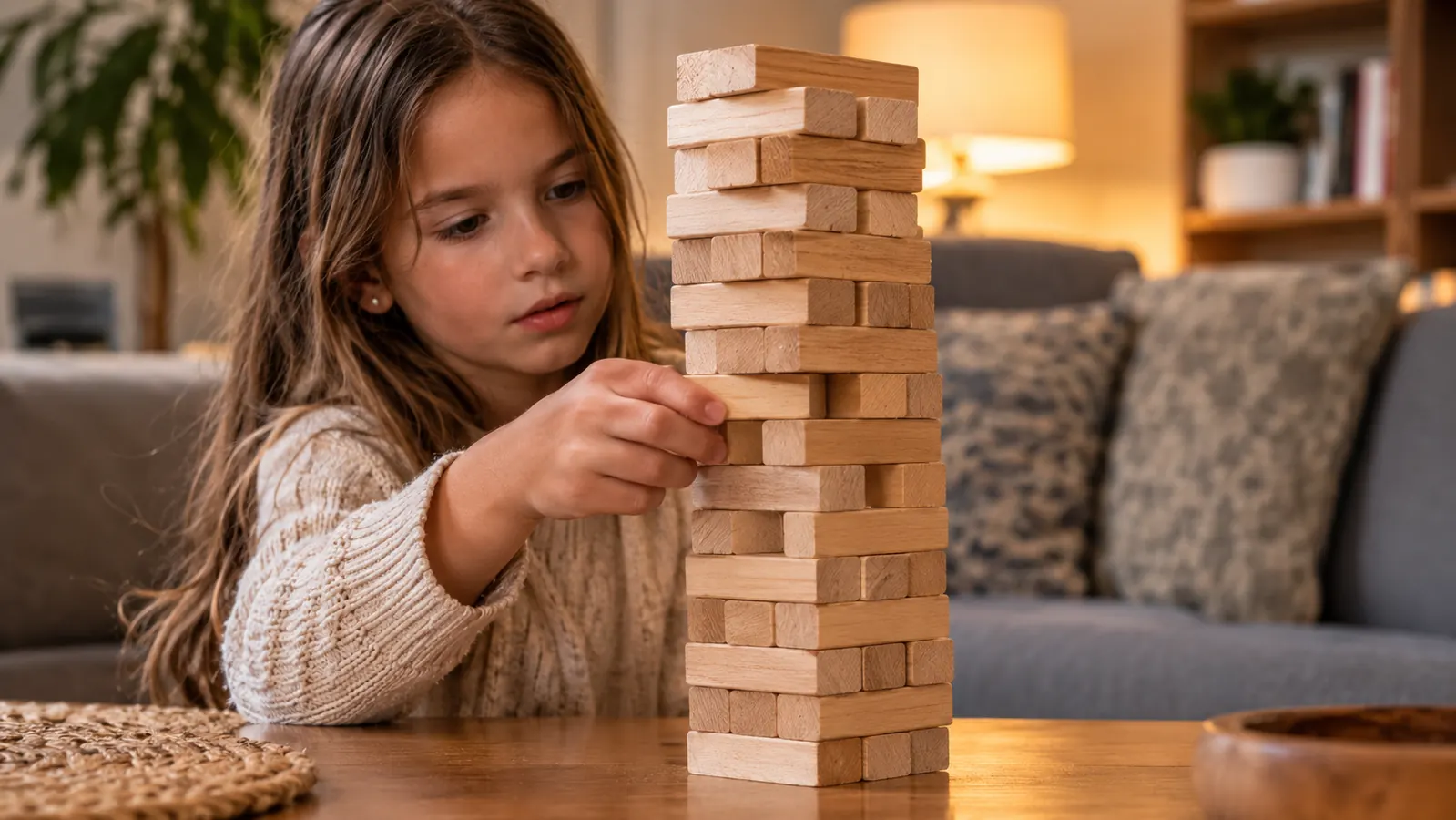
I will start with the thing Jenga does better than any board game I know. It makes a fidgety child hold still. Wyatt does not sit through Connect 4 so much as perch next to it. With the tower he leans over the coffee table with his chin nearly on the wood and holds his breath while he works a block loose. That kind of focus is hard to buy, and the tower gets it out of him for free.
There was a Sunday in the third week when the rain would not stop and the two kids from next door came over to get out of it. Four children, one coffee table, one tower. They played for close to an hour, which for that crowd is a long stretch. When it finally came down the noise brought me in from the kitchen at a run, and I arrived expecting tears. There were none. Nobody argued about who lost, because there is no score to argue about, and they stacked it right back up. I have watched those same four children fall apart over a board game that ran long and ended in a tally.
The second win is people. Connect 4 is a two player game, full stop. Jenga takes as many children as you can fit around the table, and nobody has to sit out and watch. At Wyatt's birthday there were four kids and one tower, and every one of them got a turn. The board game was not even opened that afternoon.
The third win is that a collapse is funny. When the tower goes, it goes loud, everybody shouts, and the game resets in ninety seconds. Nobody loses a score. Nobody has to be a good sport about a slow, quiet defeat while the grown-up counts discs. For a six-year-old who is still learning how to lose without stomping off, that is worth a great deal.
The game that was still on the rug five weeks later
Hasbro Gaming Connect 4 sets up in about a minute, teaches a six-year-old to plan ahead, and has taken every knock Wyatt has given it. Ages 6 and up, two players, blocker discs included.
Amazon Check Today's Price on Amazon →How We Tested This, Exactly
There was no schedule and no checklist. Both games sat on the rug by the coffee table, and I did not suggest either one. I watched what he reached for after dinner, on the rainy days, and on the mornings he woke up before I did. If a game needs a grandparent to talk it up, it is already in trouble.
The Jenga tower came out in bursts. He would stack it, play three or four rounds, then knock the rest down on purpose and walk away. That last part matters, because knocking a tower down is not the same as playing a game. The Connect 4 board came out more often and for shorter stretches, which sounds like a loss until you count the days. He played it on eleven different days. He played the tower on four.
The first thing I tried was a shelf. I put both games up high and brought one down at a time, thinking the novelty would keep him interested. That lasted four days. A game on a shelf is a game that is not being played, and by the second week neither one was coming down unless I carried it. So I gave up on the shelf and left them on the rug where he trips over them. That is when the counting started. From the second week on I wrote the day on the back of an old grocery list whenever the board came out, which is how I know it was eleven days and not the six or seven I would have guessed. Memory flatters a toy you like.
I played both games too, dozens of times, and that belongs in the count. A game a grandmother dreads opening is a game that stays in the box. I can play Connect 4 six times in a row without wanting to hide it on a high shelf. I cannot honestly say the same for the tower, largely because my hands are seventy-one years old and the blocks demand a steadiness I no longer have.
The Blocker Discs, Explained Plainly
The four blocker discs are the difference between this Amazon exclusive version and the plain one you may remember from your own childhood. The listing describes them as a way to block an opponent and lift the discs higher. In plain terms it is a fourth kind of piece on the table, and it gives you another option when your turn comes.
The first time a blocker actually did something, I used it to plug a column Wyatt had been quietly building for three turns. He stared at the board for a while, then told me that was not fair. I explained it was a piece in the box and not a trick, and he settled down. The next night he used one on me to stop a row I had going along the bottom, and he looked up to make sure I had seen it. That is the whole value of them. They turn a game a six-year-old has mostly figured out into a game with one more question in it, and questions are what keep a child at the table.
How much does that matter to a six-year-old? Honestly, not a great deal at first. Wyatt mostly liked having a piece that was different from mine. Where the blockers earn their keep is when an adult plays a child who is better than expected. They give the grown-up a way to make the game interesting again without letting the kid win on purpose, and children can smell a thrown game from across the room.
He played Connect 4 on eleven different days. He played the wooden tower on four.
The Setup and Cleanup Difference
A six-year-old's patience for setup is roughly as long as it takes to open a cereal box. Connect 4 wins this one going away. The feet go onto the grid, the slider bar slides in, and the discs come out of the box already sorted into two piles. Call it a minute, and we are playing.
We lost the slider bar for two days in the fourth week. Without it the grid will not release the discs, so the game sat idle while I dug through the couch cushions and the bin of cars under the stairs and got asked every twenty minutes whether I had found it yet. It turned up behind the couch on the second evening. That is the trade with a plastic game that comes apart in pieces. A tower of blocks has nothing to lose.
Cleanup is the one place Jenga wins outright, and I will say so. You sweep the blocks back into the sleeve and you are finished. Connect 4 means forty-six discs, and if you skip picking them up they end up in the couch cushions until spring. The blocks have their own wear problem, mind you. I have thrown out three in five weeks because a corner swelled after a night on the porch and the block started to stick, and there is no way to order a handful of replacements. I solved the disc problem by keeping a cloth bag on the shelf and making collection part of the game. Wyatt counts them into the bag. He thinks it is a rule. I am not going to correct him.
Who Should Buy Which
Buy the Hasbro Gaming Connect 4 if you have one child, or two who can take turns, and you want a game that teaches planning, ends cleanly and holds up to being dropped on a hardwood floor. It is the better first game for a six-year-old, and the better game for a grandparent who will end up playing it fifty times before spring. Buy Jenga instead if your house fills up with children on weekends, if the point of the evening is laughing and noise rather than a score, or if you already have a shelf of board games and want something the adults will still play after the kids are in bed. If you can only put one game on the rug for the next month, put the Connect 4 down first. That is the one that will still be there in five weeks.
If your six-year-old quits games halfway through, start here
Two players, ages 6 and up, about a minute to set up, and a rule that fits in one sentence. The Amazon exclusive includes the four blocker discs.
Amazon Check Today's Price on Amazon →