

Wyatt is six, in first grade, and sitting still has never been his talent. He is loud and busy and he would rather be in the backyard under the maple tree than at the kitchen table. Instructions make him irritable. Losing a piece makes him worse. So when I put the LEGO Creator 3 in 1 Space Shuttle set in front of him, I did not expect much. I expected twenty minutes, a floor full of pieces, and a boy who had already moved on to something else.
The first try went badly. He quit at page six of the booklet, pushed his chair back, and told me it was too hard. The second try went so well that he finished the whole shuttle before lunch and asked what else he could build. Nothing about the boy changed in between. What changed was the five things I did around the set, and that is what this article is: the steps, in order, the way I would tell a friend on the church steps after service.
The set that got my busy six-year-old to sit through an entire build
Three builds in one box, ages six and up, and enough snapping to hold a boy at the table. It is the one we still get down off the shelf.
Amazon Check Today's Price on Amazon →Step 1: Set the table before he sits down
The first time, I opened the box with Wyatt watching. That was my mistake. He grabbed at the bags, dumped a pile in the middle of the table, and lost interest while I was still flattening the booklet against the tabletop. Now I do the unglamorous part twenty minutes early, by myself, before he is even in the room. I open the LEGO box, lift out each bag, and set each one in its own small bowl from the kitchen, the way I used to set out vegetables for the lunch line.
The booklet goes flat on the table with a heavy mug holding one corner open. If it flips shut in the middle of a step, a six-year-old loses his place and then his temper. A mug solves it. I have done the same thing with puzzles and card games, and it works the same way every time.
I learned the hard way to count the bowls before I call him. The first Sunday I set this up, I used four bowls and the bags did not divide evenly, so one bowl ended up with about twice as much in it as the others and that was the bowl he kept digging through with both hands. Now it is five bowls, sorted by bag, and each one holds a shallow layer he can see the bottom of. A deep pile is a hunting ground. A shallow layer is a parts tray, and a boy can spot what he needs in a shallow layer without dumping it out.
By the time he sits down, the sorting is done and the only job left is building. That sounds like a small thing. It is not small for a boy this age. Every decision I take off his plate is one more minute he stays in the chair, and one more minute is the whole ballgame at six. I also turn off the television and push the chairs in. Not the floor, the chairs. He stands up to build, and a chair behind him is a thing to climb on rather than a thing to sit on.
Step 2: Build the shuttle first, and only the shuttle
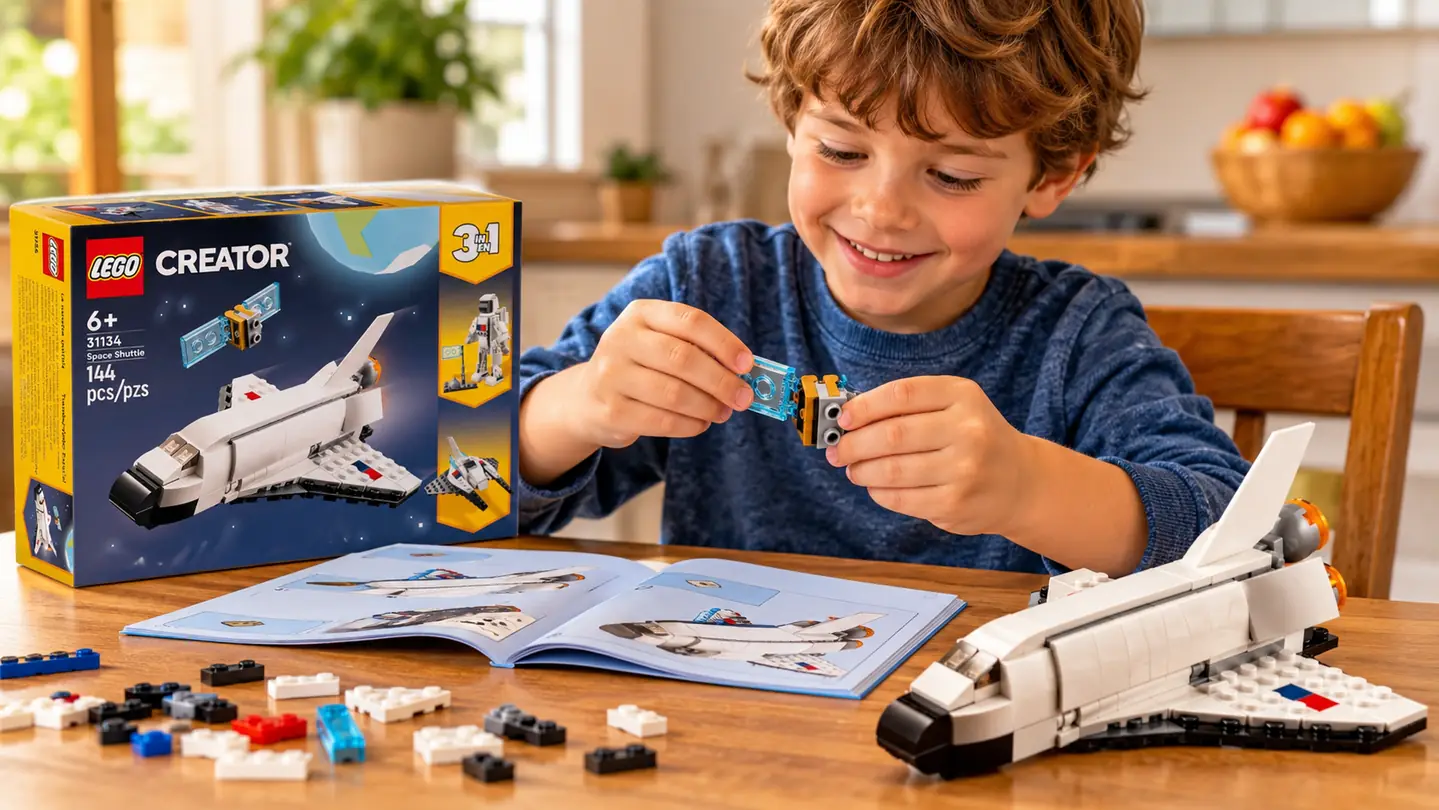
This LEGO set is a 3 in 1. He can build the shuttle, a second ship, or a posable astronaut with jointed limbs, a jetpack, and a flag to plant. I did not tell him any of that on the first day. Three choices at once is a trap for a boy who loses interest fast. He will want to build all three, he will start all three, and he will finish none of them, and then he will tell me the set is boring.
So we built the shuttle, and only the shuttle. It has an opening hatch with a removable piece inside that slides out and extends, and that hatch was the thing he kept returning to. He must have opened and closed it thirty times before we were finished. I let him. That is not a delay. That is the reason he stayed at the table at all, and I am not going to argue with a six-year-old about how he enjoys his own toy.
The other thing I did was fold the booklet so only one page showed. I tore nothing. I just creased it back along the spine so the next step was not sitting there in plain sight, tempting him to skip ahead and get lost. Before I started doing that, he would jump four pages, build the wrong thing, and then hand it to me like I had done it to him. One page at a time fixed more of that than any amount of reminding.
Halfway through, I stopped us on purpose. I said the words out loud, the way I used to say them in the cafeteria: we are stopping here. The half-built shuttle went on the top shelf of the bookcase, out of reach, and we came back after lunch. Two sittings of twenty minutes beat one sitting of forty that ends with a boy on the floor and pieces under the couch. A boy who knows the break is coming does not fight the break.
Step 3: Let him do the clicking, you do the finding
Here is the thing I had wrong for years. The hard part of a building set is not pressing the pieces together. It is finding the piece. My eyes go straight to a small plastic part on a tabletop. Wyatt's do not. He scans the whole pile, sees nothing, and starts to slide off the chair. That is not defiance. His eyes are six years old.
So I find, and he clicks. I keep the next two or three pieces for each step in a little row beside his hand, and he presses them down himself, all the way, until it snaps. The first week I did it that way, the whining stopped almost completely, and what was left was the part he actually likes. He is not at the table because he enjoys hunting for a two-by-two. He is there for the snap. Give him more snaps and fewer hunts and he stays.
One afternoon I tested it. I sat on my hands and made him find every piece for a full page and timed him without saying so. It took forty-one minutes and he quit twice inside of it, once to get a drink and once to tell me his legs hurt. The next page I went back to laying pieces out ahead of him and it took nine minutes with no quitting at all. I would rather have nine good minutes than forty-one bad ones, and so would he.
By the third session he was finding most of his own pieces and pushing my hand away when I pointed. By the astronaut rebuild he did not want help at all. That is the goal, and it arrives faster if you help too much at the start than if you help too little. The point is to keep him at the table long enough that he forgets he was ever thinking about leaving it.
Step 4: Take it apart and rebuild it into the astronaut this same week
Most people skip this part, and it is where the patience actually gets built. The first build is exciting. The second build is work. Same pieces, same table, and the instructions are different enough that he has to think again instead of running on memory. That is the difference between following a picture and understanding a thing.
We rebuilt it into the astronaut on the fourth day. The astronaut has jointed arms and legs, a jetpack on his back, and a flag he can plant on a shelf or the kitchen windowsill. Wyatt did the first four steps with the booklet open and the rest of it without the booklet at all, in about eleven minutes. This is the same boy who quit at page six four days earlier. I am not telling you he is a prodigy. I am telling you the second build is easier than the first because the fear is gone.
Taking it apart is its own lesson, and I do not let him rush it. He wanted to break the shuttle down by sweeping the whole thing off the table into the box, and I said no, we take it apart the way we put it together, a piece at a time, back into the bowls. It took us twelve minutes and he grumbled for the first four. But when we were done, every piece was accounted for and nothing was under the couch. The next time he did it on his own without being told, which is the only kind of progress I trust.
I made one rule and I hold to it. A finished build does not sit on the shelf for more than a week. Then we take it apart and pick a different one. It took two rounds before he stopped groaning when I said it was time. Now he does the taking apart himself, because he knows what comes next is another turn at the table. That is the whole lesson in miniature. The pieces are not gone. They are waiting.
Step 5: Give it a landing place
The sets that survive in this house are the ones with a home. The rest end up in a basket, and a basket is where a set goes to die. We cleared one shelf on the bookcase, at his eye level, out of the path of a running six-year-old and well away from the back door where the weather comes through.
The box is 7.52 by 5.55 by 1.81 inches, so it stacks with his other sets and does not take over the room. The whole set weighs 3.2 ounces, which means he can carry it from the shelf to the table without asking me for help, and that matters more than you would think. A boy who can get his own set down is a boy who gets it down.
We had to move the shelf once. I first put the set on the second shelf from the top, thinking it was out of the way, and within a week the shuttle was face down on the floor with the hatch snapped off, because getting it down meant climbing the bottom shelf like a ladder. Low and steady beat high and safe. It sits on the bottom shelf now, on a square of nonslip shelf liner so the box does not slide when he grabs for it, and the shuttle has not been dropped since.
The LEGO pieces are plastic, and the listing says dishwasher safe. I have never put ours in the machine. A damp cloth and thirty seconds at the end of a session has been plenty, and then the lid goes back on the box and the box goes back on the shelf. That last part is mine to do, and I do it in front of him so he sees it.
What Else Helps
Two things, and neither one costs anything. The first is to build something of your own at the same table. Not helping, just building. I keep a small pile of spare pieces beside me and click them together while he works, and I promise you he stays longer when my hands are busy too. Children do not want to be watched. They want to be joined.
The second is to stop while it is still fun. If he is laughing when the lid goes on, he comes back tomorrow without being asked. If he is crying, it takes a week to talk him into the table again, and by then the pieces are in the basket. The listing puts this set at ages six and up, and the educational note on it is creative thinking. I would add one more word to that list: finishing. That is what Wyatt got out of it, more than the shuttle and more than the astronaut. He got the feeling of a thing started and a thing finished, four days running, at six years old. You cannot buy that in most boxes.
He did the first four steps with the booklet open and the rest without it at all, in about eleven minutes. Same boy who quit at page six four days earlier.
Start with the shuttle. The astronaut can wait until Thursday.
One box, three builds, ages six and up. It is the set I hand to a boy who says building is too hard, and then I sit down beside him.
Amazon Check Today's Price on Amazon →