
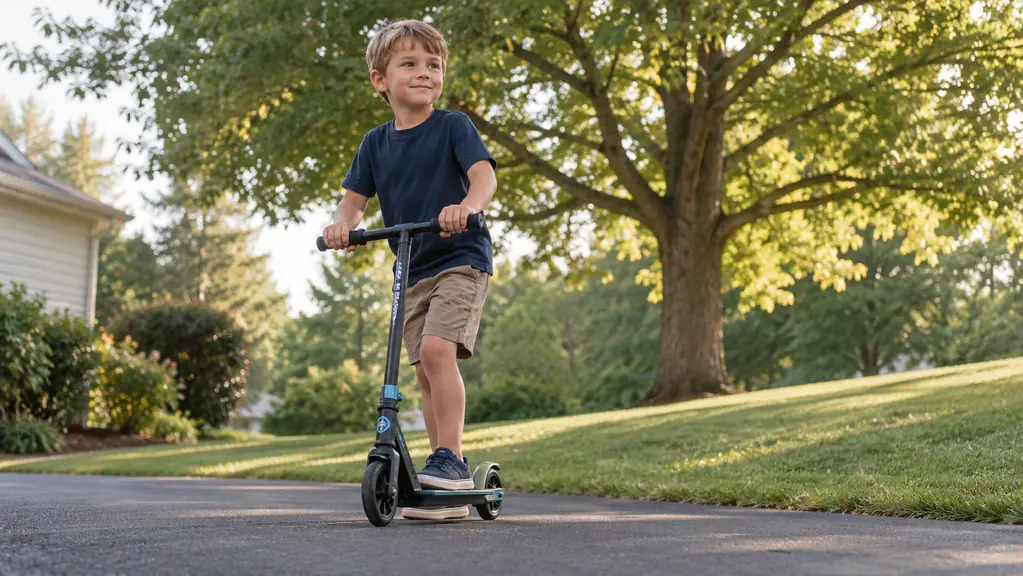
Wyatt turned six in the spring, and by June he had decided that three wheels were for babies. The neighbor boy rides a two-wheel scooter to the corner and back about ten times a day, and Wyatt watched him do it for two weeks before he asked me for one of his own. I said yes before I thought it through, because that is how these things usually go around here.
The first afternoon was a mess. I held the back of a borrowed scooter with both hands while he stood stiff as a fence post, and after twenty minutes my lower back was finished and he had not traveled six feet. So we quit. We waited a week, I read the instructions, and we started over with a plan and a Razor A Kick Scooter. It took five short sessions across two weeks. Wyatt is not a cautious child, so if this worked on him it will likely work on yours.
The scooter that made the second attempt easier than the first
Aluminum frame, adjustable handlebars, and a folding mechanism that lets it live by the front door instead of the back of the garage. That last part matters more than you would think.
Amazon Check Today's Price on Amazon →Step 1: Fit the scooter to the child before he ever stands on it
I skipped this the first time and it cost us a week. The Razor A has easy-adjust handlebars and the handle height goes up to 36 inches, so there is a real range to work with. Set the bar so the top sits just above his waist when he is standing flat on the ground. Then watch him for a minute. Wyatt kept dropping his chin to look at his feet, so I raised it one notch, and the looking-down stopped almost immediately.
Next, check that the folding mechanism is clicked all the way into place. This is the original folding mechanism Razor puts on the A model, and it is meant to release, which is exactly why you check it every single time before a ride. Grab the stem and give it a firm pull. If it moves, it is not locked. Then spin both wheels with your hand and make sure they turn free and the rear fender springs back when you press it.
The last part of the fit is the weight of the thing. The Razor A is 4.6 pounds. That number sounds like a spec sheet line until you watch a six-year-old try to pick up something heavier at the bottom of the porch steps. Wyatt can carry this one himself, which means he gets it out and puts it away without me, and a toy a child can handle alone is a toy that gets used.
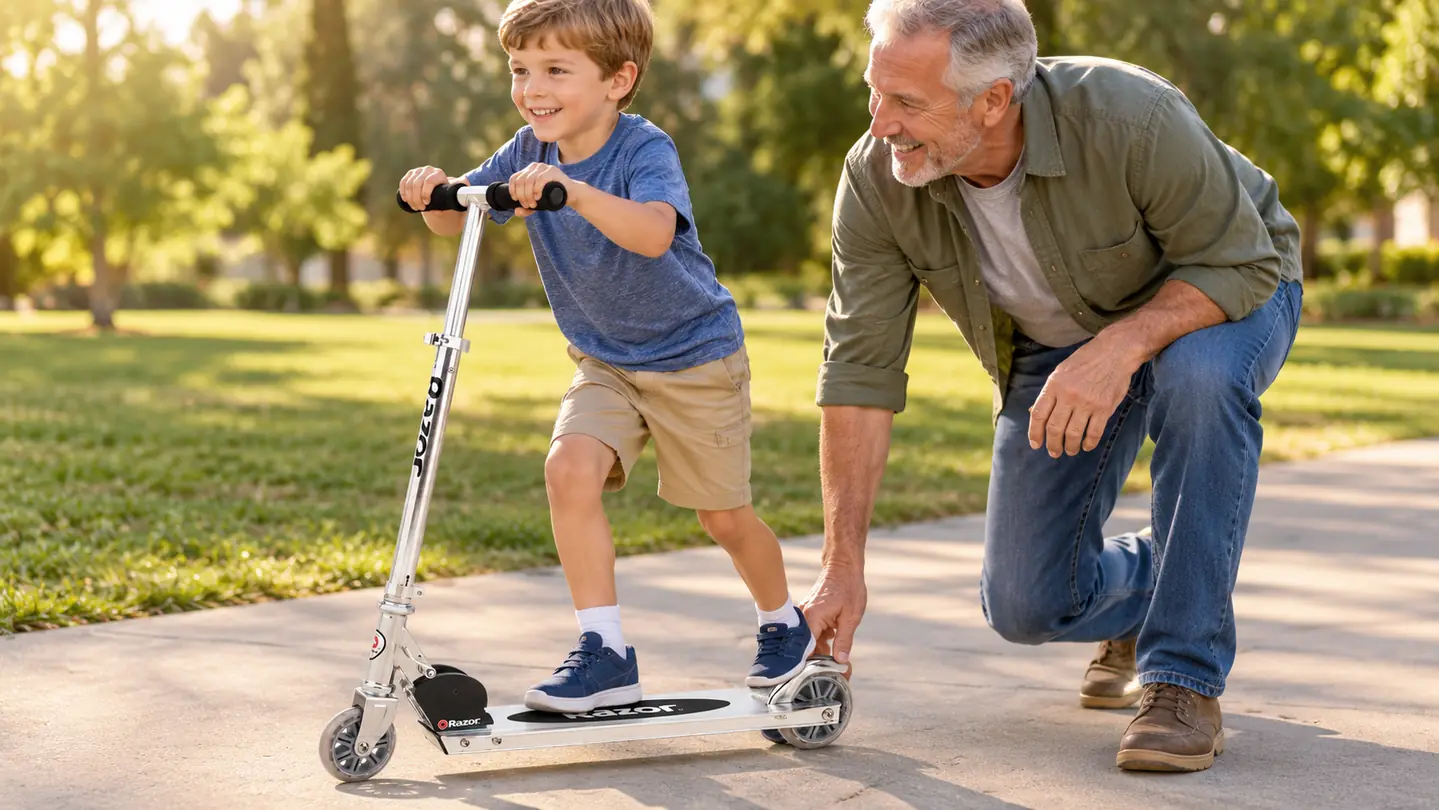
Step 2: Pick the surface and set the rules before the wheels touch it
Smooth pavement, and nothing else, for the first week. Not grass, not gravel, not the cracked stretch of sidewalk near our mailbox where the roots have pushed the concrete up into a little ramp. Our driveway is asphalt with a very slight slope toward the street, and that was close to ideal. The slope gives him a small amount of motion without him having to earn all of it with his pushing leg.
I measured that driveway with a tape from the garage door down to the street: a little under forty feet, and the drop across the whole run is maybe six inches. That sounds like nothing. On a scooter it is enough that one push carries a six-year-old most of the way down, which meant Wyatt got the feeling of rolling before he had to master the push. We used those same forty feet every session for two weeks. Same start line, same finish line, same seam between the two concrete slabs down near the bottom.
Shoes with flat soles, laced tight. Wyatt tried it in sandals once and the deck was slippery under his front foot, so that ended. Helmet on before the scooter comes out of the garage, not after. I made it a rule with no negotiating: no helmet, no scooter, and I hold the scooter until the buckle is fastened. Six-year-olds argue with reasoning but they fold fast when the rule has no wiggle in it.
I also set one boundary that afternoon and did not move it: he stays on the driveway until I say otherwise. The street is not part of this lesson. Having the line drawn before he got on meant I never had to chase him, and he never had to hear me yell.
Step 3: Teach the push and the glide on flat ground, one foot at a time
Here is where most of us rush. The first skill is not steering. It is standing on a moving deck without grabbing at the handlebars for dear life. I had Wyatt put his front foot across the deck, sideways, near the front wheel, and his back foot flat on the pavement. Then he pushed once, gently, and let both feet ride for a count of two.
Two seconds. That was the whole goal for session one. He wanted to go fast and I wanted him to feel the scooter roll under him while he was still calm. The Razor A has a rear suspension, and on our driveway he could feel the seam between the two concrete slabs without it jolting him, which kept him from tensing up every time he crossed it.
The second session ended early and badly. I let him start at the very top of the driveway instead of halfway up, and the extra speed scared him. He put both feet down at once, the deck caught him behind the ankle, and he sat down hard on the asphalt and cried. We went inside. The next afternoon we started from the halfway mark again and stayed there for three days. That is the whole lesson of this step: distance is the thing you add last, not first.
We counted out loud. One push, two seconds, stop. One push, three seconds, stop. By the end of the third session he was gliding eight or nine feet and stepping off on his own, and the grin had arrived. That is the moment to quit for the day, not the moment to add something new.
The Razor A weighs 4.6 pounds. Wyatt can carry it up the porch steps himself, and a scooter he can handle alone is a scooter that actually gets used after the first week.
Step 4: Add the turn once gliding has gotten boring
A two-wheel scooter does not turn like the three-wheel one he had at four. On the Razor A, a turn is a lean, not a yank. I stood at the bottom of the driveway and had him ride toward me, then tip the handlebars a hair in the direction he wanted to go and let the scooter do the rest. The first few tries he overcorrected and had to step off, which is fine, because stepping off is a skill too.
The first turn we set up was too sharp. I put a plastic bucket at the bottom of the driveway as a marker and told him to ride around it, and he went straight at it and stopped dead. Six-year-olds steer toward whatever they are looking at, which is why the bucket was a mistake. I took it away and stood in the same spot instead with my hands out. He rode at me and tipped the bars a little to miss me, and that worked, because he was watching my face and not a bucket.
The foam grips helped here more than I expected. Wyatt's hands are small and he squeezes hard when he is concentrating, and the foam gives him something to hold without the bar digging into his palms. His steering settled down once he stopped white-knuckling.
The wheels are 9.8 centimeters, solid urethane, and they do not soak up much. That is the tradeoff for never having to pump a tire. Keep turns at walking speed on smooth pavement and they behave fine. Take the same turn at speed on a rough surface and a small rider will feel every pebble.
Step 5: Teach the brake and the fold-up routine in the same session
The rear-fender brake is the part I made him practice before I let him go any faster. Press down on the fender with the back foot, the scooter slows, and then you step off. We did it at a walking pace, over and over, until pressing the brake was automatic and not something he had to think about. A brake you have to remember is a brake that arrives too late.
The first real brake test was a near miss. I had him press the fender while he was still moving at a decent clip, and he pressed too hard and too suddenly and nearly went over the front. The fender works best as a slow, steady press you lean into, not a stomp. So we went back to walking pace and practiced that for five solid minutes, until the stop was smooth and he stayed upright every time.
Then the fold. The Razor A folds at the stem, which means it can live by the front door instead of behind the lawnmower. I made Wyatt fold it and unfold it himself five times that first evening. He thought it was a trick, which was fine by me, because now he does it without being asked and the scooter is always where he can reach it.
One number worth knowing: the maximum weight capacity is 143 pounds. Wyatt is nowhere near that, so this scooter has years left in it. It also means the adults in the house do not get to take it for a spin. I tried. It held, but the handlebars were at my knees and it was a poor idea from the start.
What Else Helps
Keep sessions short. Fifteen or twenty minutes, then put it away while he still wants more. Our worst afternoon was the one where I pushed for just five more minutes, and it ended with him on the ground and me carrying the scooter back to the garage. A child who stops while he is winning asks to come back out tomorrow.
I timed ours after that. Session one was nineteen minutes. Session three was eleven, because he got the glide early and I called it while he was happy. The long ones were never the good ones. Somewhere around the twenty-minute mark a six-year-old's attention turns from the scooter to whatever else is in the yard, usually the garden hose, and once that happens you are not teaching anybody anything.
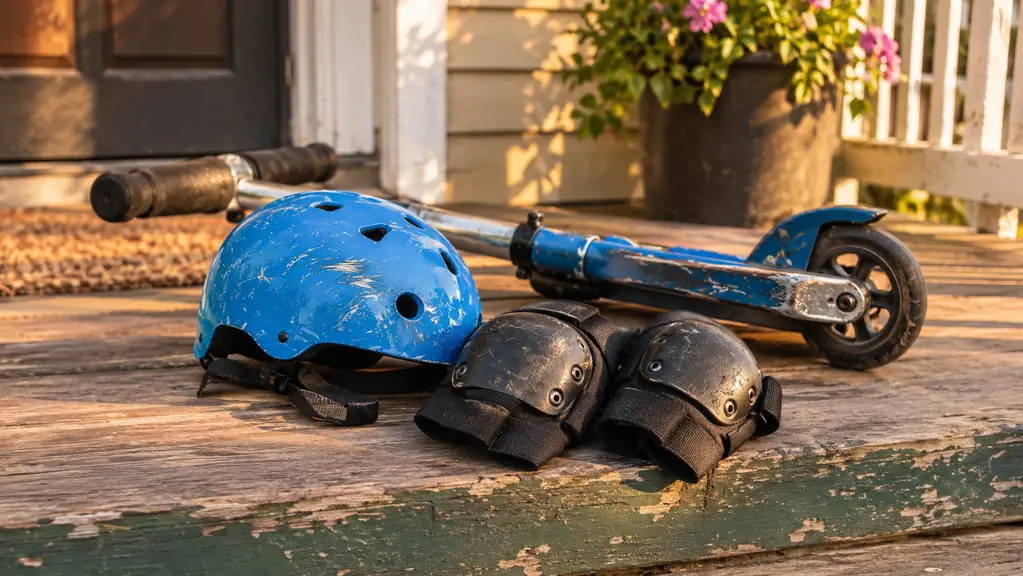
Knee pads and elbow pads earn their keep in week two, not week one. In week one he is going slow and stepping off carefully. In week two he is confident and taking corners too fast, and that is when the scrapes happen. Having the pads already in the garage means you are not arguing about them at the wrong moment.
The other thing that helped was another kid. Once Wyatt could glide, the neighbor boy rode alongside him and Wyatt copied everything he did, including the leaning turns I had been trying to teach for three days. Sometimes the lesson lands better from a seven-year-old than from a grandmother.
And watch what he reaches for after the first week, not the first hour. The first hour is novelty. A week out, Wyatt was still dragging the Razor A out of the garage on his own before breakfast, and that told me more than any reaction on day one. If you want the longer picture on how this scooter holds up to a kid who is hard on toys, the long-term notes are worth a read, and if you are still deciding between two wheels and three, that comparison will save you some guesswork.
Five short sessions beats one long afternoon, every time
The Razor A folds flat, adjusts to a six-year-old's height, and weighs less than a gallon of milk. Start on a smooth driveway and let him set the pace.
Amazon Check Today's Price on Amazon →