
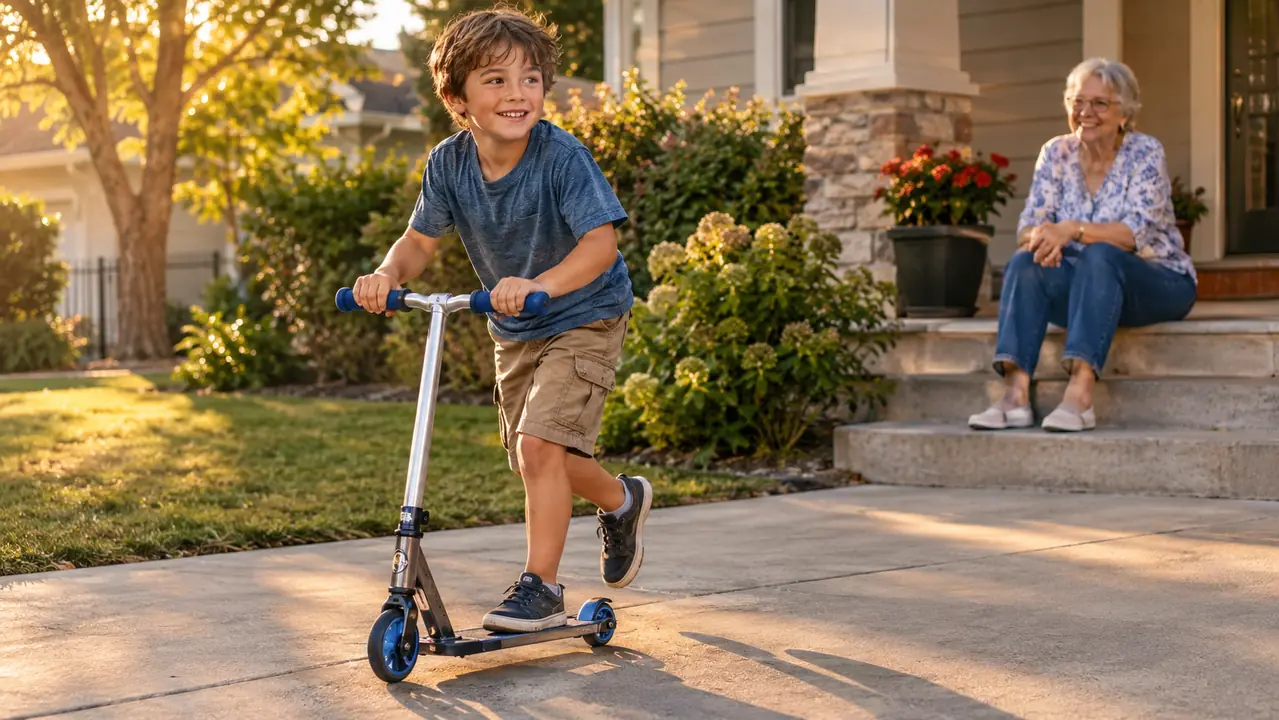
Wyatt asked for a scooter for eleven weeks straight. I counted, because I am the sort of grandmother who counts things. When the Razor A Kick Scooter finally came out of the box, I expected the happy part. What I did not expect was twenty minutes on my knees in the carport with a folding latch that would not cooperate while a six-year-old asked me every nine seconds whether it was ready yet. That is the part of this review you will not see in the product photos. The scooter is good. Wyatt rides it most afternoons. But there are three things a grandparent should know before the box shows up, and one of them nearly sent it back to the store.
Here is my situation, so you can decide whether it matches yours. Wyatt is six, in first grade, hard on toys, and quick to lose interest in anything that takes too long to figure out. I have been raising him since he was four. We try new things on the rug in the living room first, then in the fenced backyard under the maple tree. I do not grade a toy on the first hour. I grade it on what he still reaches for after the first week, and I grade it on whether I have to fix it, tighten it, or explain it more than once.
The Quick Verdict
A genuinely light, well-built scooter that a six-year-old can learn on, held back by a folding latch that fights small hands and a balancing curve that will test your patience before it rewards it.
Amazon Check Today's Price →The Scooter That Survived Week Two
Wyatt still asks for it after school, which is the only test I trust anymore. Look at the handlebar height range before you order, because that is the setting that decides whether the first week goes well or badly.
Amazon Check Today's Price on Amazon →The short version is this. The scooter is well made and genuinely light, and once Wyatt understood the balance he could steer it without thinking. The two things that gave us trouble were the folding mechanism, which is stiff when the scooter is new, and the first several days of learning to stand on two wheels instead of a wide stable base. Neither is a dealbreaker. It is just the honest shape of the thing, and it is why I am writing this instead of handing you a list of compliments.
How I Actually Tested It
We started indoors, which sounds silly for a scooter and is not. The living room rug is forgiving, and it let Wyatt get the feel of standing on the deck without the scooter shooting out from under him. He fell twice on the rug and laughed both times. On concrete he would not have laughed, and I suspect we would have lost a week to nerves. I know that because I tried the concrete first. The box arrived on a Tuesday afternoon and I had it out in the carport before supper, thinking a smooth flat surface was the obvious place to start. He stepped on, pushed off, and the front end slid away from under his sneakers before he had gone four feet. He did not cry. He just got off and said he would do it later, and later had a tone to it. It took two days on the rug to get him back on without that wary look.
After two days of rug practice we moved to the driveway, then to the packed dirt at the edge of the backyard. I timed nothing and measured nothing fancy. I watched three things instead: whether he could get on and off by himself, whether he could stop when he wanted to stop rather than when he ran out of room, and whether he asked for it again the next day. Those three answers tell you more about a toy than any specification sheet ever will. I wrote the answers on the back of an envelope, mostly so I would not fool myself later. By the end of week one the first was a yes, the second was a yes on flat ground, and the third was a yes every single day, including the rainy one where he had to settle for sitting on it in the hallway.
I also rode it myself. I am seventy-one and I am not going to pretend I took it down a hill, but I stood on it, pushed off twice, and pressed the brake with my heel. That told me the deck holds a grown adult without flexing and the brake responds to a light press rather than a stomp. The weight capacity listed for the scooter is 143 pounds and I am comfortably under that, but it was still worth feeling the thing under my own feet instead of guessing from a photograph. I did it on the flat part of the driveway with Wyatt watching from the porch and giving instructions, which he enjoyed considerably more than I did.
What Nobody Tells You About the Folding Mechanism
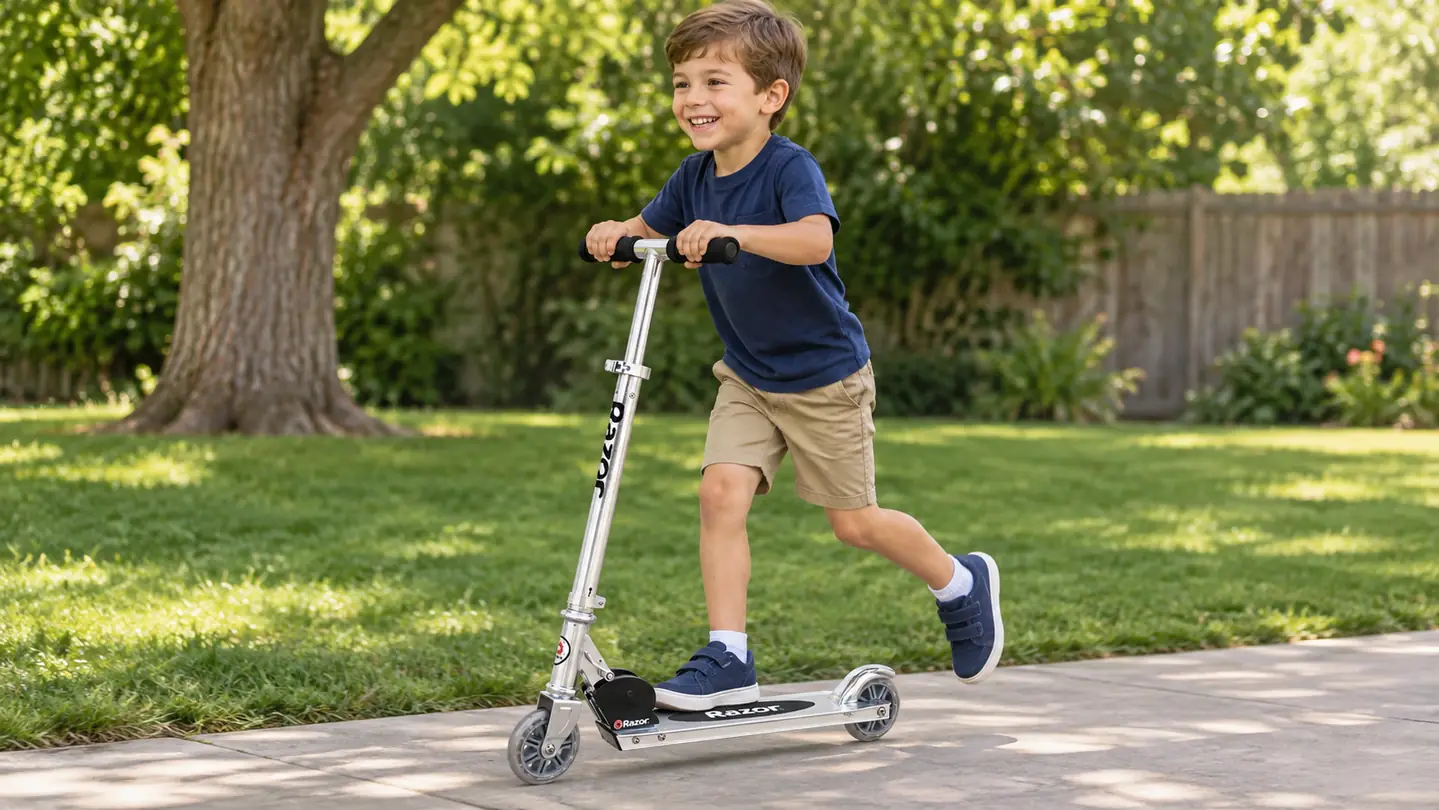
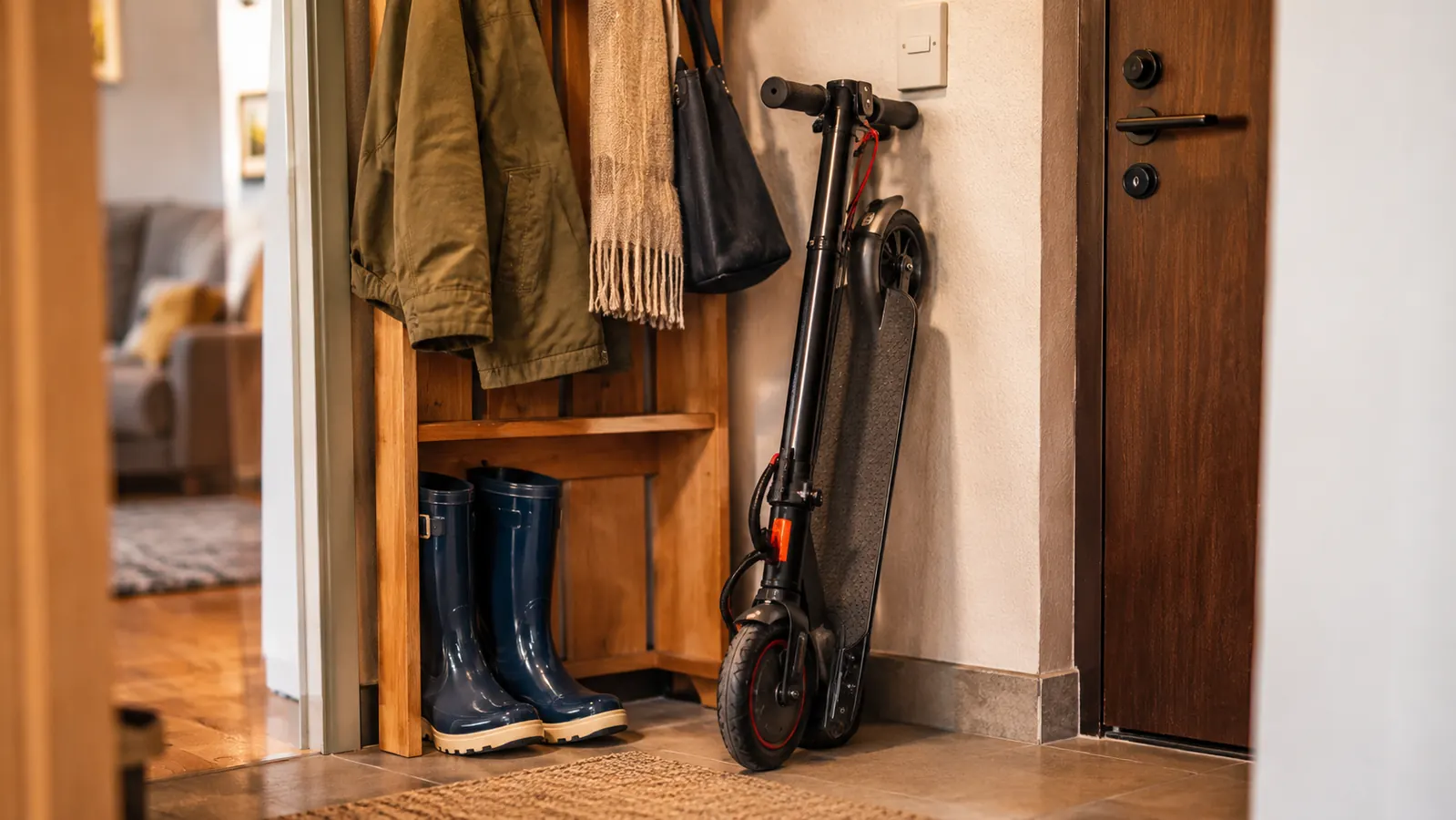
The folding mechanism is the feature that sold me and the feature that nearly undid me. It is the original Razor design, and it does exactly what it claims: the scooter collapses so it can be carried and stored. That matters in a small house. Ours stands folded beside the coat rack in the entryway and takes up less floor space than a pair of rain boots. When we visit my sister, it goes in the trunk without a fight. I measured it against the gap once, mostly out of surprise, and folded it slides into a space narrower than the vacuum cleaner does.
What the product listing does not tell you is that the latch is stiff when the scooter is new. Stiff enough that Wyatt could not work it on his own for the first week, and stiff enough that I needed both hands and a firm pull the first several times. The first evening I tried it one-handed while holding the front wheel steady with my knee, and I got it on the fourth attempt with a good deal of muttering. It loosened with use. By the second week he could manage it with me talking him through it, and by the third he could do the whole thing himself as long as I held the handlebars steady so the front end did not swing away from him. If your child is impatient, expect a few days of being the one who folds it.
The other thing nobody mentions is that the folding joint is a pinch point. Not a dangerous one, and not one that drew blood at our house, but a spot where small fingers can get caught if a child is in a hurry. We made a rule on day one: he asks, I fold. That rule has held for three weeks without an argument, which for a six-year-old is a small parenting victory I will take credit for. He recites it back to visitors now, which is both charming and a little embarrassing.
The scooter weighs 4.6 pounds. That means I can carry it in one hand and hold a six-year-old's hand with the other, which is the only specification that has ever actually mattered to me.
The Handlebar Height Is the Whole Ballgame
The handlebars adjust, and the range is generous. The listing gives a handle height of 36 inches at the top of that range, with overall dimensions of 24 inches long, 11.25 inches wide, and 32.5 inches tall. For Wyatt we set them near the low end and he was comfortable from the first push. The important part is that the clamp holds. I checked it every few days for the first month and it has not slipped once, including after the afternoon he decided to find out how fast he could go down the slope where the driveway meets the street.
Here is the advice I would give any grandparent. Set the handlebars before the child sees the scooter. If they are too high, a new rider leans back and the front wheel starts to feel loose and scary under him. If they are too low, he hunches over and complains that his back hurts and you spend an afternoon confused about why a child who begged for a scooter does not want to ride it. I set ours at the kitchen table on a Saturday morning with the scooter upside down on a towel so it would not scratch the linoleum, and that was the right way to do it.
One caution about setting it. The clamp is not a flip lever, so changing the height takes a few minutes and some patience, and it is a job for a kitchen table rather than something you do in the driveway in ten seconds. That is good for safety and mildly irritating if two children of different heights share one scooter, because you will be loosening and retightening that clamp every time they trade off. At our house there is one child and one setting, so it was a five-minute job and I have not touched it since. If you expect to hand this down between siblings a year or two apart, budget for that.
The First Three Days, Honestly
I want to be straight with you about the learning curve, because this is where the reviews I read beforehand were too cheerful. Two wheels is two wheels. A child has to learn to balance, and that takes days, not minutes. Wyatt is a confident kid on a playground and he still spent the first afternoon stepping on, wobbling, stepping off, and looking at me like I had handed him a trick question. By the end of that afternoon he had traveled maybe thirty feet in total and most of it with one foot dragging along the ground for insurance. He also wanted to hold my hand the entire time, which is hard on a grandmother's back and very easy to say yes to.
What got us through it was short sessions. Ten minutes, then inside for a drink. Ten more, then lunch. Day one was stepping on and off, nothing more. Day two he pushed off twice in a row and glided about six feet before putting his foot down, and you would have thought he had won something. By the third day something clicked and he was pushing off and gliding the length of the driveway with his feet up. If I had pushed for a full afternoon on day one, I think he would have quit. If your child is younger or more cautious than Wyatt, budget a week instead of three days and everyone will be happier for it.
Wheels, Brake, and What the Ride Feels Like
The wheels are solid urethane, roughly 9.8 centimeters, and they never need air. I want to be clear about why that matters to me personally. I have pumped up bicycle tires for a six-year-old at seven in the morning exactly once in my life, and I have no intention of repeating it. Solid wheels mean the scooter is ready whenever he is, which on a Saturday morning is worth more than any improvement in ride quality I could name.
The tradeoff is that solid wheels pass every bump straight up through the deck. On a smooth driveway and packed dirt he glides. On the cracked sidewalk at the end of our street he feels every seam, and he slows down on his own without being told to. There is one slab near the mailbox that has lifted about an inch on one side, and he stops dead at it every time, gets off, walks the scooter over, and gets back on. I used to think that was fear. It is not. It is a child learning what his wheels can do, and it has kept him off the pavement I would rather he avoided anyway.
The brake is a rear fender brake, the kind a child presses with his heel. Wyatt understood it in one afternoon, which surprised me more than anything else about the scooter. There is rear suspension as well, and while I cannot claim it transforms the ride at the speeds a six-year-old reaches, the scooter does not rattle him the way I expected on uneven ground. The foam grips are comfortable, they have not torn, and his hands have not slipped off them even in July heat, which is more than I can say for the plastic handles on his old wagon.
What I Liked
- Light enough at 4.6 pounds that a small child can pick it up and carry it himself
- Folds flat for storage in a small entryway or a car trunk
- Adjustable handlebars that hold their setting once tightened
- Solid urethane wheels that never need air
- Rear fender brake a six-year-old learns in a single afternoon
- Aluminum frame that has survived drops, kicks, and one trip down two porch steps
Where It Falls Short
- Folding latch is stiff when new and hard for small hands to work
- Folding joint is a pinch point for fingers in a hurry
- Solid wheels make rough pavement feel genuinely rough
- Handlebar height adjustment is not a quick release, so it takes a few minutes
- Two wheels means a real balancing curve, not a same-day skill
On durability, here is the honest report after a few weeks of hard use. The frame has one small scuff on the side from the porch steps and nothing else. The brake has not worn through. The folding joint has not developed a rattle, which was my main worry after that stiff first week. I have tightened the handlebar clamp once, and that was preventative rather than necessary. The foam grips have held up better than the seat on his bicycle did. For a toy that gets dropped on concrete most afternoons, that is a better record than I expected.
Who This Is For
This scooter suits a child who is ready to balance and who has the patience for a few days of wobbling. If your child is six or older, has ridden a tricycle or a balance bike, and does not fall apart when something is hard for an afternoon, this is a good fit. It also suits a household with limited storage, because the fold is real and useful rather than a marketing bullet point. And it suits a grandparent or parent who ends up carrying the thing half the time, because 4.6 pounds is the difference between one hand and two. The Razor A is a sensible first two-wheel scooter for a kid on the tall side of the age range, and the adjustable handlebars mean it will still fit him next spring without a new purchase.
Who Should Skip It
Skip it if your child is four or five and small for his age. The balance demand will frustrate him and you will spend a month coaxing. A three-wheel scooter with a wide base is the smarter first step, and there is no shame in waiting a year. Skip it if your child is the type to fold and unfold things fifty times a day without asking, because the pinch point on that joint is real and I would not want to test it unsupervised. Skip it if you live somewhere with nothing but broken pavement, since solid wheels will make every ride a rattling chore. And skip it if you want something that arrives ready to ride, because the handlebar height setting and the stiff new latch both require an adult the first time. None of that is a knock on the scooter. It is a knock on buying the wrong scooter for the wrong child, which is the more common mistake by far.
One last thing, and then I will get out of your way. What sold me on this scooter in the end was not any single feature. It was the second Saturday, when Wyatt came out of his room already wearing his shoes and asked if we could go out back before breakfast. A toy that gets a six-year-old outdoors before breakfast is doing its job. The latch will loosen. The wobble will pass. Buy it for a child who is ready for two wheels, set the handlebars low before you hand it over, and keep an eye on that folding joint for the first week.
A Scooter He Will Still Ask For in April
Three weeks in and it is still the first thing Wyatt reaches for after school. Check the current listing, confirm the handlebar range fits your child, and plan on an adult helping with that latch for the first few days.
Amazon Check Today's Price on Amazon →