

Wyatt asked for a science kit the way he asks for most things, at full volume, in the middle of a store. He is six, in first grade, and he has been taking things apart since he could hold a screwdriver. So I put two boxes on the kitchen table. One was the Elenco Snap Circuits Beginner SCB-20, which the maker lists for ages 5 to 9. The other was a science experiment kit, the sort that comes with powders, goggles and a booklet. I wanted to know which one he would still reach for after the new wore off. That is the only test I trust anymore, and it has never once lied to me.
Here is the short answer. For a six-year-old who gets frustrated when instructions are too fiddly, the Elenco Snap Circuits Beginner is the better first kit. It is the one that is still out in week three. A science experiment kit gives you the louder first afternoon, and then most of it is used up. If you want a gift still sitting on the living room rug a month from now, buy the Snap Circuits. If you want one big rainy Saturday and you are willing to sit right beside him, the experiment kit does that job well.
| Snap Circuits Beginner SCB-20 | Science Experiment Kits | |
|---|---|---|
| What is in the box | A snap circuit base board, the snap circuit modules, and an illustrated beginner manual | Powders, liquids, goggles, test tubes and a booklet of experiments |
| Recommended age | 5 to 9 years, stated by the manufacturer | All over the map, many kits start at 8 |
| How the child works | Presses plastic modules onto a base board until the project is built | Measures, pours and mixes in cups and tubes |
| Reusable | Every piece goes back in the box and works again tomorrow | The consumables run out and the kit is finished |
| Mess | Dry plastic parts on a flat table | Real, sometimes on the table, sometimes on the floor |
| Range of science | Electrical circuits, one branch of science, done properly | Chemistry, crystals, reactions, sometimes rocks |
| Manual | Illustrated manual written for a beginner | Varies by brand, often dense reading for a six-year-old |
| How much adult help | Sort the parts once, then look in every so often | An adult stays for the measuring and the cleanup |
| Durability | Plastic, and warranted against defects in manufacture | Thin plastic and glass, and a spill can end a piece of it |
| Where it ends | 21 projects, then you move up to a bigger set | When the supplies run out, usually within a week |
| Best for | A kid who will rebuild the same project until it is perfect | A kid who wants the fizz and the colour change |
What Comes in Each Box
The Elenco box is honest about what it is. Inside you get the snap circuit base board, the snap circuit modules, and an illustrated manual written for a beginner. That is the whole list, and I appreciate a list I can finish reading. The parts are plastic, and the kit weighs about half a pound, so Wyatt can carry it from the shelf to the kitchen table by himself without asking me. Elenco lists 21 unique projects. It is not a kit you add powder to, it is a kit you finish and then hand down or step up from later.
The box itself is small enough to sit on the shelf beside the puzzles, and I put it there on a Thursday and left it alone on purpose. I wanted to know whether he would ask for it without me suggesting it. He asked on Saturday morning, before breakfast, which is a good sign for anything in this house. The manual is the first thing to read, not the parts. That is the only part of the setup that needs me, and it took one sitting at the table with a cup of coffee going cold beside me.
The science experiment kit is a different animal, and the honest answer is that it depends which one you buy. The ones I have had through this house came with powders, test tubes, goggles and a booklet. Some are put together well. Some are a plastic tray of disappointment with one good reaction in it. The thing they all share is that they are built around consumables. You use the powder, the powder is gone. That is not a knock on the whole category, it is just what the category is, and it matters when you are buying for a child who plays with things twice.
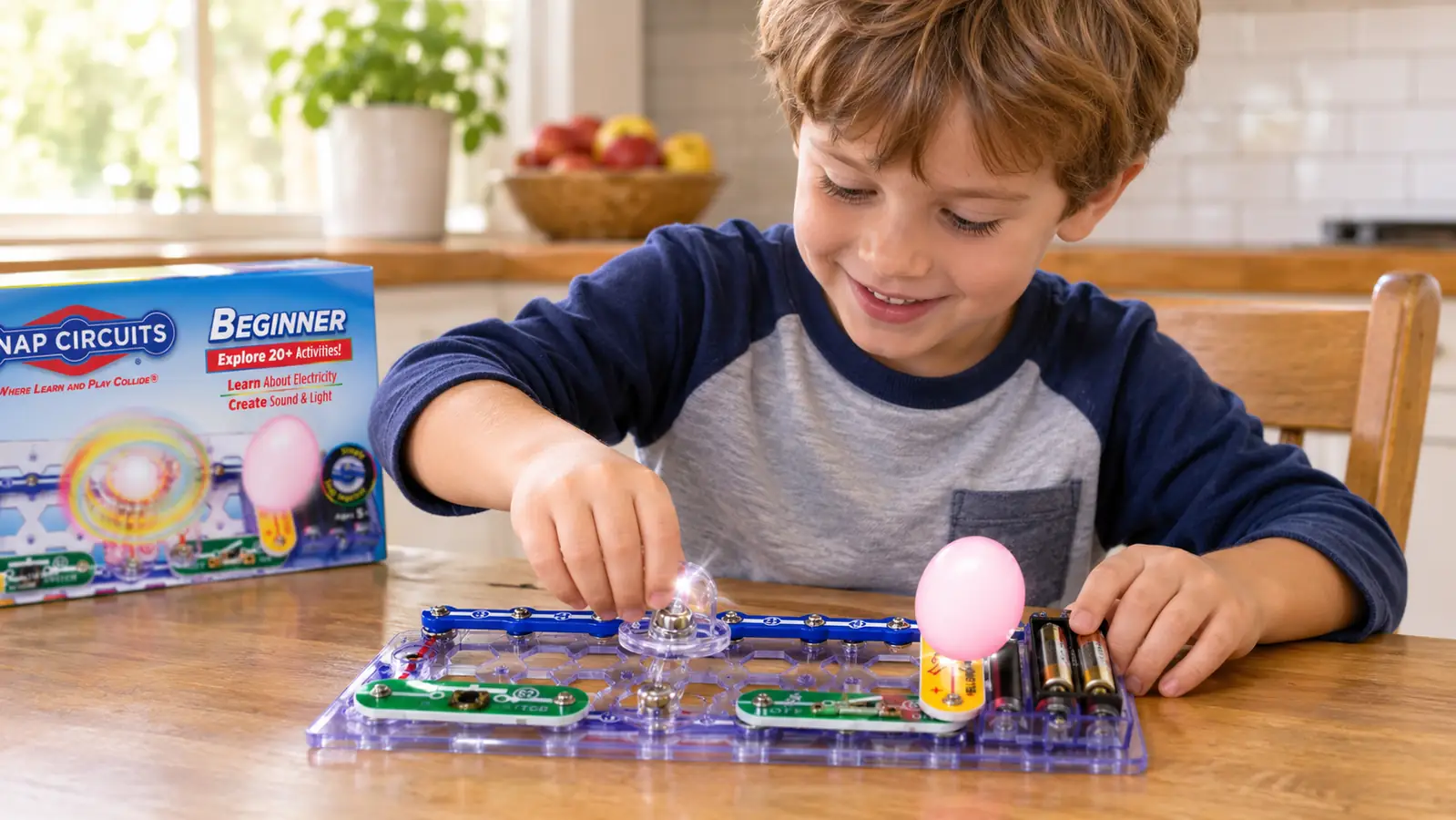
Where the Elenco Snap Circuits Beginner Wins
It wins on the second week, and the second week is the only week that counts. Any toy gets an hour. The question is whether it gets a Tuesday afternoon when there is nothing else to do and the tablet is put away. The Snap Circuits kit was still on the rug on day eighteen. Wyatt had a project he could not get right on the first try, and that bothered him enough to come back to it after supper. The experiment kit had lost three parts and most of its powder by Sunday night, and there was nothing left to come back to.
The project he was stuck on was the one in the manual with the most steps, and I know that because he counted them out loud. He had the modules in the wrong order twice before it worked. I did not fix it for him, which took some doing on my part. When it finally came on he did not cheer. He sat back on his heels and looked at it for a while, then took the whole thing apart and built it again from the start, and that second build took him a fraction of the time.
It wins on mess and on my patience. There is no mixing, no pouring, no cup of water on the kitchen table, and nothing to wipe up afterward. The parts live in one box. When he is done, he puts the modules back and the base board goes on top. For a grandmother who is not looking for another craft project to supervise at seven in the evening, that is worth a great deal. The kit is rated from age five, and the pieces are plastic and made to be pressed together, which suits hands that are still learning how much force to use.
It wins on the manual. The illustrated manual is written for a beginner, and that phrase is doing real work. Wyatt could follow the pictures with me reading the words once. He could not read a chemistry booklet at six and neither could most first graders. A kit a child can operate himself builds something a kit he has to wait on me does not. Elenco also warranties the kit against defects in manufacture, which matters with a boy who is hard on toys. Twenty-one projects is a real list, and it is also a finite one, so plan on a bigger set later.
The Snap Circuits kit was still on the rug on day eighteen. The experiment kit had lost three parts and most of its powder by Sunday night.
Where Science Experiment Kits Win
They win the first hour, and they win it easily. There is nothing like watching a six-year-old's face when something fizzes over the rim of a cup. Snap Circuits cannot do that. Circuits are quiet, they are patient, and the payoff is a project that works rather than a small explosion. If your child is the sort who needs a visible reaction to stay interested, a chemistry kit speaks his language in a way a base board never will.
They also win on range. A science experiment kit can wander through chemistry, crystals, reactions and sometimes rocks, and that wandering suits a kid who has not decided what he likes yet. The Elenco kit teaches one branch of science and teaches it well, but it does not teach you about acids or growing crystals. The other honest point in their favour is that the mess is the point. Some children learn by pouring, and a parent who can live with a towel on the table will get more out of a science kit than a child whose parent flinches every time a cup tips.

How Wyatt Played With Both, Week by Week
The first afternoon was a tie, and I will be fair about that. He went for the powders first because they were louder. We ran the first two experiments in the booklet with a towel under everything and the goggles on, and he talked about the bubbles for the rest of the day. He asked for a third and I said no, because I wanted there to be something left for another day. That turned out to matter less than I thought it would. Then I opened the Snap Circuits box and he sat with the base board for forty minutes, which for this child is a long stretch. He got frustrated twice. He wanted the project to be finished before he had built it. I let him be frustrated and did not take it over, and about the third try it worked.
By day three the pattern was clear. He asked for the circuits after school. He asked for the powders once, and I said we were out of the one we needed, and he shrugged and went outside to the maple tree. That shrug told me more than any review could. A toy that survives a shrug has to be doing something right, and a toy that does not survive one is not a toy, it is an afternoon.
By week three he had a favourite build he did over and over, the way some kids watch the same movie eleven times. He liked being able to take it apart and start again with no adult handing out supplies. He also liked showing it to his friend from down the street, and the two of them did not fight over it, which is close to unheard of in this house. I still keep the science kit on the top shelf for a supervised Saturday. It has not been down since.
What I Liked
- Every piece is reusable, so the kit works again on Tuesday
- No mixing, no pouring and nothing to wipe off the table
- Illustrated beginner manual a six-year-old can follow with a little help
- Rated from age 5, which fits a first grader with small hands
- 21 unique projects listed, enough to keep a builder busy for weeks
- Warranted against defects in manufacture
Where It Falls Short
- Teaches circuits only, no chemistry or crystal growing
- 21 projects is a finite list, so a bigger set comes later
- A lost module can stop a project until you write for a replacement
- Needs a flat surface, a rug with a bump under the board makes it harder
- Quiet by nature, no fizz, no pop, no colour change
Twenty-one projects, and every piece goes back in the box for the next one
This is the kit that was still on the rug in week three at my house. Ages 5 to 9, an illustrated beginner manual, and no powders to run out.
Amazon Check Today's Price on Amazon →Who Should Buy Which
Buy the Elenco Snap Circuits Beginner for the child who repeats things. The one who builds the same tower forty times, who wants to get it exactly right, who gets annoyed at himself and tries again. Buy it for a first grader who can follow pictures, for a house where the adult on duty does not want a supervised chemistry session at bedtime, and for a grandparent who wants a gift that is still being used at Thanksgiving rather than one that was finished before the wrapping paper was in the bin.
Buy a science experiment kit for a different child. Buy it for the one who needs the fizz, who asks why the volcano bubbles, who will happily sit with you and a towel and stir things for an hour. Buy it when you have that hour to give and you do not mind spending it at the kitchen table with your sleeves rolled up. Buy it as a treat rather than a toy, knowing the supplies will be gone and that is fine. Some children need to see the reaction before they care about the why. There is nothing wrong with either child, and I have raised both kinds.
The Fiddly Parts Nobody Warns You About
The Snap Circuits manual is a reading job the first time, and a six-year-old cannot do it alone. Plan on sitting with him for the first project and maybe the second. The first one took us about twenty minutes, most of it me reading and him pointing at the picture. The second took ten. By the fourth he was building on his own while I made supper, and that is the whole arc you are buying. The base board needs a flat table, so the rug with the lump under it is not the place. And if a module goes missing, a project stalls until you sort it out, so the box goes back on the shelf every single time. I am strict about the box and it has saved me a hundred arguments.
The science kit's fiddly part is the supervision, and it is not optional. Powders in the eye are a real thing, the goggles in the box are there for a reason, and the booklet is written for a reader older than six. I stay at the table the whole time, which is why we do it on a rainy Saturday and not after school. I would say the same thing about any kit in that category, cheap or otherwise. If you cannot sit with him, wait a year or buy the circuits.
The one he is still playing with comes with 21 projects and no cleanup
If you want the kit that survives past the first afternoon, this is the one I would put under the tree. The pieces are plastic, the projects reuse every part, and it is rated from age five.
Amazon Check Today's Price on Amazon →