
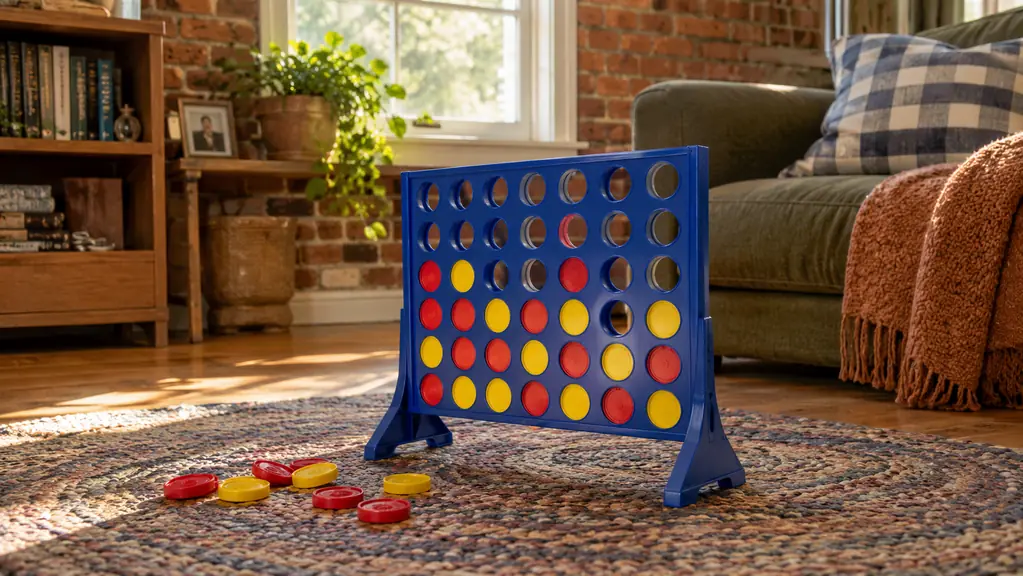
Connect 4 has been sitting on my living room rug for three weeks now, and I have lost to my grandson more times than I plan to admit in print. He is six. I am seventy-one. That is the honest starting point for this review. The version in my house is the Hasbro Gaming Connect 4 Strategy Board Game, the Amazon Exclusive edition, sold for ages six and up. It is the same idea I remember from the fellowship hall at my church back in the seventies: you drop a disc, it falls, you try to get four in a row before the other person does. What nobody told me before I cut the tape on the box is that this edition changed a handful of things, and not every change is an improvement.
I am not a toy reviewer by trade. I ran a school cafeteria for twenty-six years, and before that I raised two children of my own. Now I am raising Wyatt, who came to live with me when he was four. I test toys the way I always tested things in the cafeteria, which is that I put the thing in front of the child and then watch what he still reaches for after the first week. The first hour tells you nothing except how good the packaging is. Three weeks in, this game is still on the rug, and that is the single strongest thing I can say about it.
The Quick Verdict
A genuinely good two-player game that a six-year-old can learn in one sitting, with real thinking hiding behind a simple idea. Most of what annoys is small, and most of it comes from the box holding no case and no room for a third player.
Amazon Check Today's Price →The Game That Survived Week One Without Being Abandoned
Two players, twenty-one discs each, and a rule set a first grader picked up before supper was on the table. Today's price is on the Amazon listing.
Amazon Check Today's Price on Amazon →What Nobody Tells You Before You Buy
The first thing nobody says out loud is that this is a two-player game and only a two-player game. It says so on the box, in small print, beside the number of players. It does not say what that means on a Tuesday afternoon when there is one adult in the house. It means I am the second player. Every time. If you are picturing a family of five gathered around the coffee table, understand that three of them are watching. That is not a flaw in the game, it is the design, but it is the detail that decides whether this gets played or goes in the hall closet.
The second thing is the length of a round. Ours run four to six minutes. The box estimates about thirty minutes of playing time, which in this house translates to a best-of-five series with a snack in the middle. That is a good thing for a six-year-old and I am not complaining about it. A short round means a loss is over before it turns into a sulk. It also means you can quit in the middle without anybody feeling robbed, which matters more than people who do not live with small children realize.
The third thing is the setup, such as it is. The box holds a grid, two feet that snap onto the bottom, a slider bar, twenty-one red discs, twenty-one yellow discs, and four blue blocker discs. That is the whole inventory. Snapping the feet on took me about a minute the first time and about four seconds every time since, and Wyatt does it himself now. But the feet come off when the thing gets dragged across the rug, which it does, and then the grid leans and the discs shift and somebody has to start the round over.
How We Actually Play With It
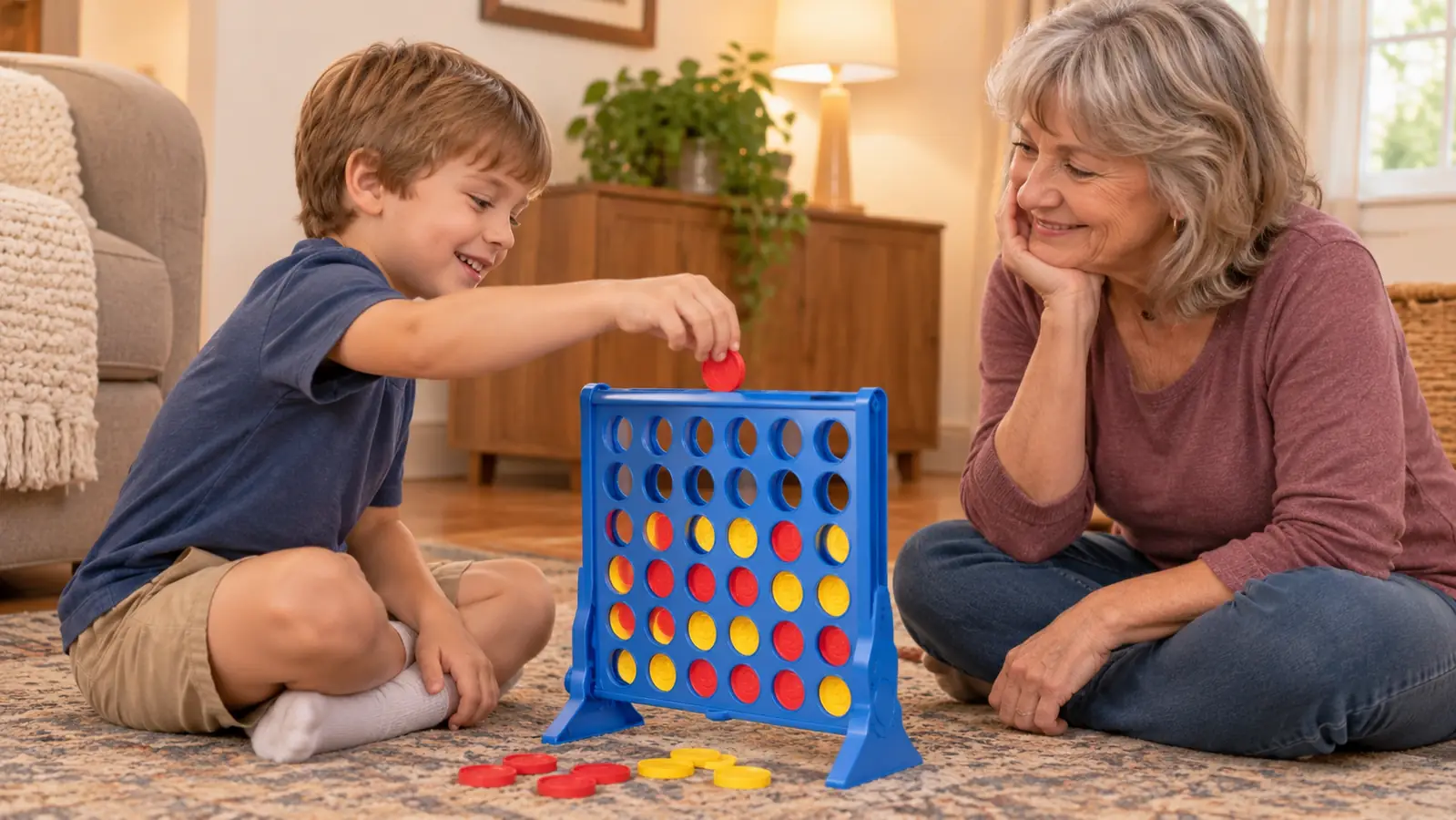
The routine is the same most weekdays. Wyatt comes off the school bus, drops his backpack by the door, and pulls the grid out to the middle of the rug before he has had a snack. He counts his discs out loud, which is how I know he is really six. Twenty-one. Then he says the same thing he says every afternoon, which is that he is going to win this time, and most days lately he is right. I have stopped assuming I will beat him, and I have stopped being surprised when I do not.
The first two days he did not play the game at all. He filled the grid. Every slot, top to bottom, both players mixed in together, because he wanted to see the whole board full. That is a six-year-old doing exactly what a six-year-old should do with a new object, and I let him do it. Somewhere around day three he started noticing that my discs were lining up, and he began dropping his discs in the way of mine, and that was the afternoon he started playing Connect 4 instead of building with it.
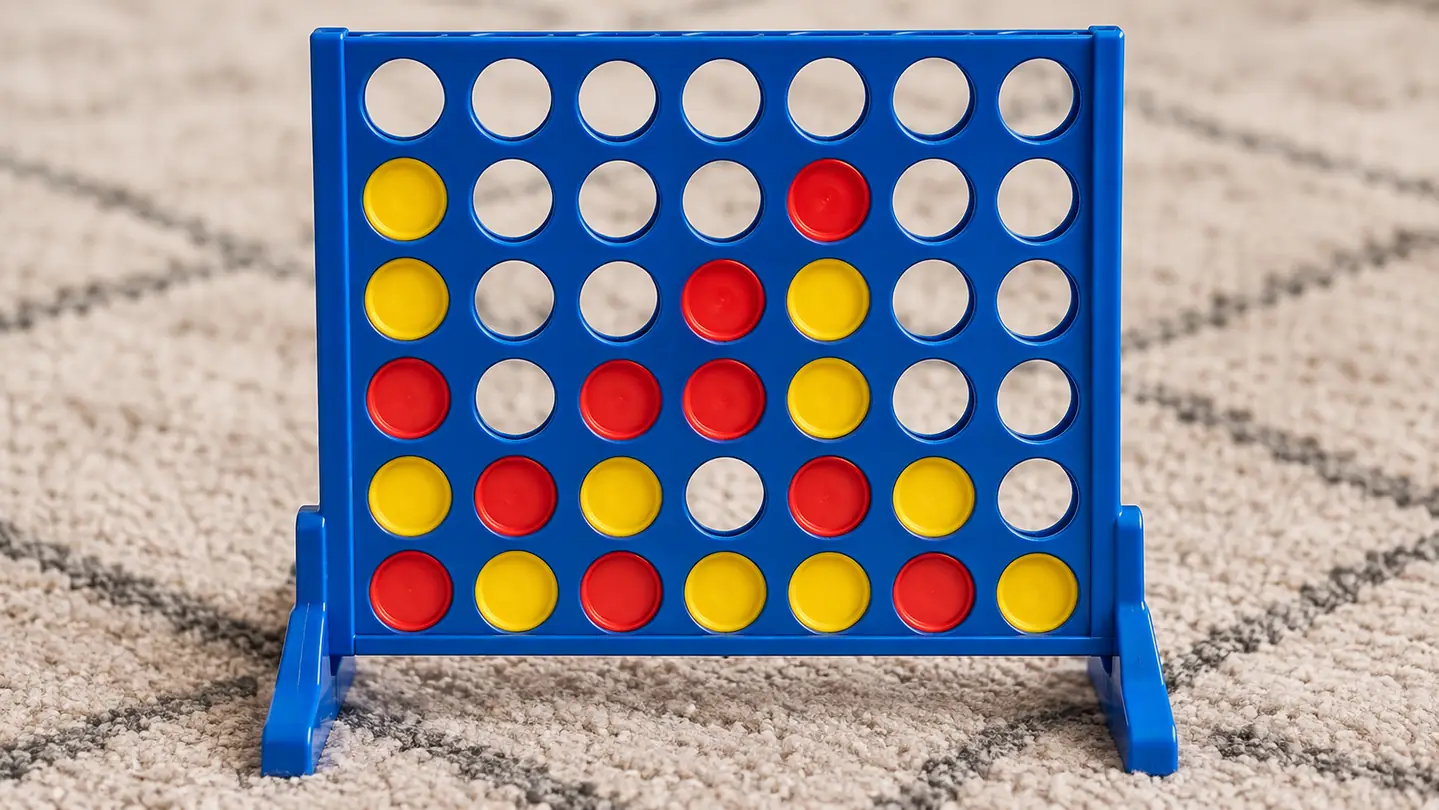
The whole game turns on the diagonals. A child can see a row across the bottom and a column going straight up with no help at all. The slant is the part that takes a week. When Wyatt finally saw one forming and blocked it without being told, he stood up and pointed at it and made me look. That was the moment this stopped being a toy and became a thing he could think about. If you are buying it for a six-year-old and you wonder whether it is too simple, the honest answer is that it is simple for about six days.
The Blue Blocker Discs, and Whether They Matter
This Amazon Exclusive edition includes four blue blocker discs, and the listing says they let you block an opponent and lift the discs higher in the grid. In our house they lasted about three days. Four special pieces in a set of forty-six is a very small addition, and the rule that governs them is one more thing to hold in a six-year-old's head on top of the thing he just learned. Wyatt tried them, decided they were confusing, and put them in the kitchen drawer. I have not been asked for them since.
Where I think they earn their place is with an older child, eight or nine, who already wins every round and needs the game to shove back at him. The blockers change what a full column means, and a kid who has mastered the plain rules will find something new to chew on for a while. My honest advice to the parent of a six-year-old is to leave them in the box for a year. And do keep track of them, because they are the same size as the regular discs and they roll under furniture just as well.
Where It Gets Annoying
The slider bar is the one real aggravation. When a round ends, you push the bar and every disc in the grid drops out at once onto the rug. Nothing catches them and nothing keeps them together. They scatter, and the four blue ones scatter into the same pile as the red and the yellow, and then you are on your knees sorting by color while a six-year-old tells you to hurry up. It is not a broken design. It is a design that assumed the game would be played on a table with a bowl within reach, which is not where we play.
The storage situation is worse than the release. Nothing in the box holds the discs. No bag, no lid, no case. The grid stands on its feet and the forty-six discs live loose unless you supply your own container. Ours are in a plastic tub that once held butter cookies, and that tub is now part of the game as far as Wyatt is concerned. If you are giving this as a gift, do the parents a kindness and drop a zipper bag in with it, because they will not think of it until the first disc goes missing under the couch.
The last annoyance is the one I cannot blame on the manufacturer, which is that Connect 4 teaches a child how to lose and it does not do it gently. Short rounds help. Losing three in a row does not. We had one afternoon in week two that ended with the grid tipped over and a boy in his room with the door shut, and I want to be honest that this happened, because a review that says a competitive game is all smiles with a six-year-old is not a review, it is an advertisement.
Three Weeks Later: What Held Up
Nothing has cracked. The whole thing weighs sixteen ounces, so it is light, and it has been knocked over, dragged across a rug, dropped on its side, and used once as a ramp for a toy truck. The Hasbro Gaming grid is still square and the feet still snap on. The discs are scuffed along the edges from being pushed down through the slots, which I expected and do not mind. For a hard plastic game that a rough boy handles every day, three weeks with no real damage is a fair result.
The interest curve is what I watch closest. Week one it came out every day, twice on Saturday. Week two it came out most days. Week three it came out maybe three times, and one of those was because I suggested it. That is not a failure. In my experience most toys get two days and then get forgotten under the couch. What keeps this one alive is that it needs me. He cannot play it alone, so it turns into a thing we do together, and that turns out to be the reason he asks for it.
What I Liked
- A six-year-old understood the rules in one sitting, with no help after the first round
- Turn-based and two-player, so the adult is actually playing instead of supervising
- Rounds run four to six minutes, short enough to survive a school night
- Hard plastic grid that has taken three weeks of rough handling without cracking
- The diagonal win teaches real spatial thinking, and you can watch it land
Where It Falls Short
- Two players only, which means one adult is committed every single time
- No bag, no lid, no case: the forty-six discs live loose
- The four blue blocker discs are one rule too many for a six-year-old
- The slider bar dumps the whole stack on the floor at the end of every round
- The listing states no warranty, so treat it as a hard plastic game and nothing more
- Losing is taught here and it is not gentle
A child can see a row across the bottom on day one. The slant is the part that takes a week, and the slant is where the game actually starts.
Whether He Is Learning Anything From It
I did not buy this as an educational toy, and I am suspicious of anything sold that way. But I will tell you what I have watched happen over three weeks. He plans a move one turn ahead now, which he did not do in week one. He sees a column getting tall and understands that whoever drops into it last gets the top slot, so he counts. He counts the slots, he counts his own discs, he counts how many turns until the column fills. That is arithmetic happening on a rug without anybody calling it arithmetic.
The other thing it teaches is the plain fact that you can do everything right and still lose, because the other player saw the diagonal first. That is a hard lesson at six and a useful one at any age. I have watched him lose a round he played well and come back the next afternoon with a different plan, and I have watched him win one he should not have and be quiet about it for a minute before he celebrated. I cannot prove this game is responsible for either. I can tell you it is the only thing in this house that has produced that particular face on him, the one where he is thinking instead of reacting.
The House Rules We Had to Make
We have three rules that are not in the instructions. Wyatt goes first on school days, because a win before supper makes the whole evening easier and I do not care who starts. We play best of three, not five, on a school night. And if the grid gets flipped over in anger, the round does not count and nobody gets a point. That last one came from him, not from me, and I have honored it every time he has invoked it.
The other thing I changed was my own behavior. For the first week I let him win a couple of rounds because it seemed kind. He figured it out by day six, and being handled made him angrier than losing ever did. Now I play to win, and when he beats me he knows it is real. He has beaten me eleven times in three weeks, and he counts them out loud, and I would not trade a single one of those losses for the easier version of the game. The Hasbro Gaming rules sheet is one page and it does not cover any of this, which is fine. That part is the grandmother's job.
Who This Is For
This is for a child around six who can sit through a five-minute turn-taking game and who likes to build and arrange things. Wyatt builds, and the filling-the-grid phase he went through tells me that was the hook for him. It is also for a grandparent or an aunt or an uncle who wants a game that puts them across from the child instead of beside him watching. And it is for a house where the adults are willing to be the second player, because the game does not function without one. A quiet table and a free half hour is all the setup it needs, and it is the sort of thing that will still be in the closet when the child is ten, which is more than I can say for most of what comes through this house.
Who Should Skip It
Skip it if your child is in a stretch where losing is unbearable. The short rounds help but they do not prevent a bad afternoon, and no game fixes that particular stage. Skip it if you need something for more than two people, or something to take to a restaurant, because forty-six loose discs will not survive a booth. Skip it if you want a toy that occupies a child while you cook, since this one requires you to sit down. And skip it if your child still puts small things in his mouth, because the discs come out of the grid and they end up on the floor more often than you would like.
Two Players, One Rug, and About Twenty Minutes
If you have a six-year-old who can take a turn and a free half hour after school, this earns its spot in the closet. It has earned its spot in mine, and I am still losing to him.
Amazon Check Today's Price on Amazon →