

Wyatt is six, in first grade, and he is hard on things. He has pried the back off a toy cash register with a butter knife and dropped a metal detector off the porch steps to see what would happen. So when people tell me to start him on STEM toys, I listen. Then I watch what actually survives a week on my living room rug. Most of it does not.
The problem with the kits I brought home was never the idea. It was the hands. Tiny screws, wires that fray, a booklet written for an adult. Wyatt would lose interest waiting for me to do the hard part, and the kit would go in the closet with the lid still on. The Elenco Snap Circuits Beginner SCB-20 is built for the opposite problem. The pieces snap down onto a base board, the manual leads with pictures, and Elenco rates the set for ages 5 to 9. Wyatt sits in the middle of that range. A month in, it is still on my kitchen table.
The kit that does not need an adult to do the hard part
Snap Circuits Beginner SCB-20 from Elenco: a base board, snap modules, and an illustrated manual with 21 projects, rated for ages 5 to 9. Nothing to screw, nothing to strip, nothing to break by being six.
Amazon See the Snap Circuits Beginner on Amazon →Step 1: Open It on the Kitchen Table, Not the Rug
The kit is three things: a base board, a set of snap modules, and an illustrated manual. On the rug, small pieces vanish into the nap and the project turns into a hunt. On the table, everything stays where he puts it and I can see the whole build from the stove. My table is not fancy. It has done play dough, puzzles, and now this.
Before Wyatt touched anything, I sat with the manual for ten minutes by myself. It is picture first, so I could see what the finished build should look like without reading a page of type. That mattered more than I expected. When I know the target, I keep my hands off his work. When I do not know it, I start pulling pieces out of his fingers, and that ends the session.
Then I set the rules. The board stays flat on the table. Modules go back in the box at the end, not in a pocket. Wyatt is a boy who will absolutely put a thing in a pocket, so we said it out loud the first three times. He rolled his eyes. He also stopped pocketing pieces.
Step 2: Build the First Project with Your Hands in Your Lap
The manual starts with the simplest build and works up from there. That order matters for a six year old. The first project is short enough that he can finish it before he is tired of it, and finishing is the whole point of day one. A kid who ends the first session with something that works will come back to it. A kid who ends it waiting on me will not.
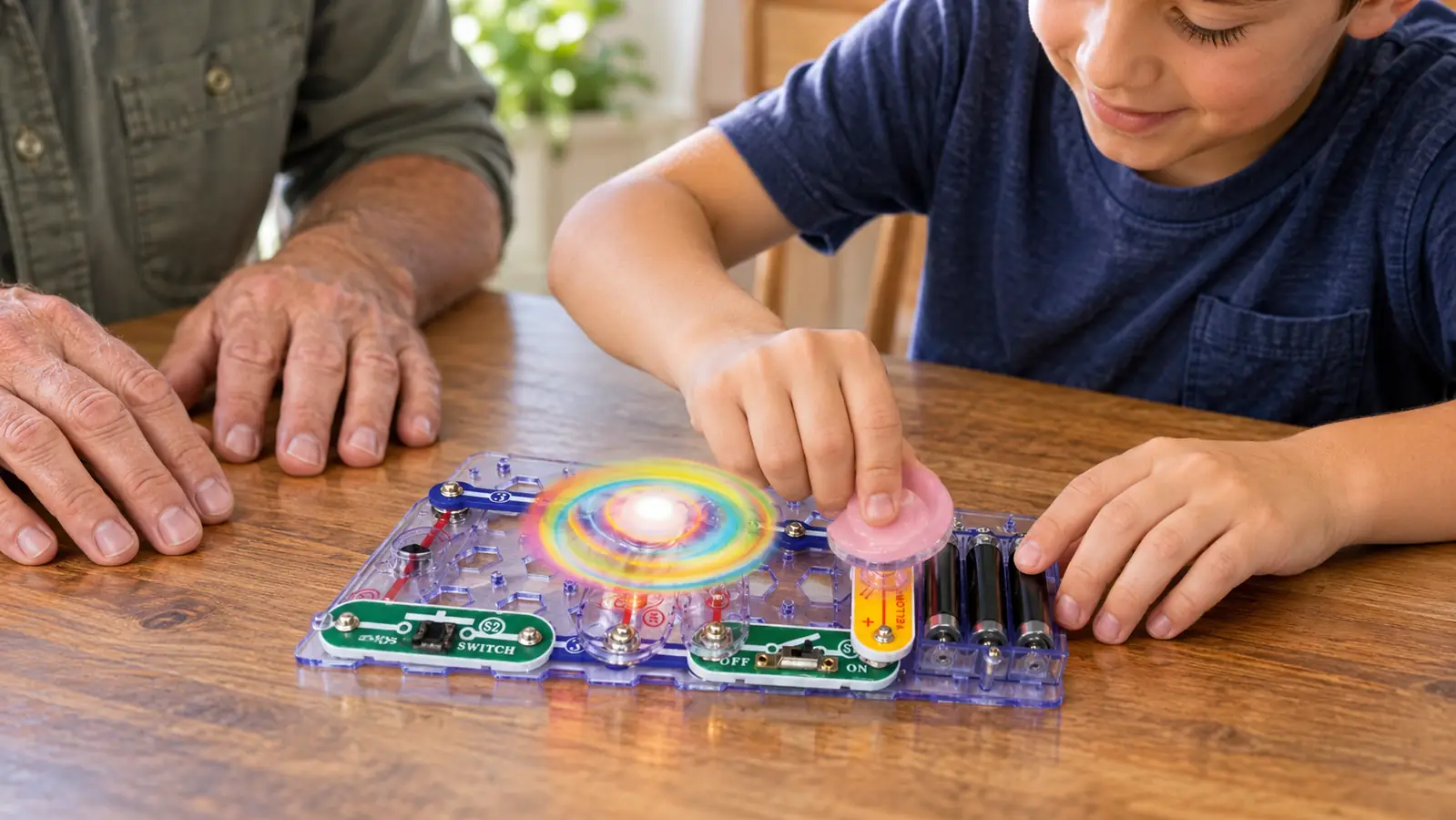
That first afternoon I sat on my hands. He pushed a module on crooked and it did not sit flat. He looked up at me. I said, take it off and try again. He did, and it seated with a press he could feel. That is the design working in his favor. The snap either seats or it does not. He gets a physical yes or no from the toy instead of a lecture from me.
Nothing here needs a screwdriver and there is no wire to strip. I have watched Wyatt break things by being exactly as rough as a six year old is, and this kit has not handed him a way to do it. A month of steady use later, the modules still snap and the board still sits flat. That is a low bar and a lot of toys miss it.
Step 3: Let Him Build the Same Project Three or Four Times
This is the step I got wrong first. I wanted to move on because I was ready to move on. He was not. Wyatt built the same project four afternoons running, and each time he was faster and less careful in the good way, the way that means he trusts his own hands.
Repetition is not wasted time with a young kid. The first build is him following a picture. The third build is him reading the picture. By the fourth he was telling me what each part did before he set it down, and I had not taught him any of that.
The repeats also catch mistakes early. On the second pass he put a module in the wrong spot, and because he had done it right the day before, he caught it himself before he called me over. That is worth more than a new project. He learned what right looks like by building it twice.
Step 4: Teach the Check, Not the Fix
Every kit eventually does nothing. That is normal, and it is the most useful part of the whole thing. When Wyatt's build did nothing, my first instinct was to slide the pieces straight and hand it back so we could move on. I made myself stop doing that.
Instead I ask three questions and then I wait. Are all the snaps flat? Does the picture in the manual match what is on the board, one for one? Is the board flat on the table and not half on your knee? He answers them out loud now. Nine times out of ten the answer is in one of those three and he finds it himself.
The habit is the point. Check the simple thing before you decide the toy is broken. He says that now, in those words, and he says it about other things too. Elenco built a kit that fails in ways a kid can see and fix. Plenty of toys fail in ways only an adult can diagnose, and then they go in the closet.
Step 5: Change One Thing at a Time
Once he trusted the manual, he got brave about it. He wanted to move a piece and see what happened. I made one rule. Change one thing at a time, and say out loud what you think will happen before you do it. Then do it and look.
That is where the kit stretches for us. The Beginner set lists 21 projects, and we have not worked through all of them. He has gone back and reworked earlier builds with one part shifted more often than he has built anything new. Elenco wrote the manual as a ladder, each project standing on the one before it, and a kid who understands the ladder will climb it sideways if you let him.
I keep a pencil and an inexpensive notebook on the table for this part. He draws the build he just finished and marks the part he moved. That was his idea. I only supplied the paper. It slows him down in a good way, and it gives me something to look at besides the back of his head.
What the First Week Actually Looked Like
Day one was twenty minutes and one project and he was done. Day two he asked for it before dinner, which I did not expect. Day three was a short session that ended with a module on the floor and both of us tired. Day four he rebuilt an earlier project without being asked. By the end of the week he knew where the board went and what the manual was for. That is a slow week by toy standards and it stuck.
I write it down because a lot of what I read would have you believe a six year old sits for an hour. Mine does not. Twenty minutes on a good day, twice, is the honest number, and the kit is sized for that. Short sessions and a shelf to put it back on beat one long afternoon every time.
He gets a physical yes or no from the toy instead of a lecture from me.
What Else Helps
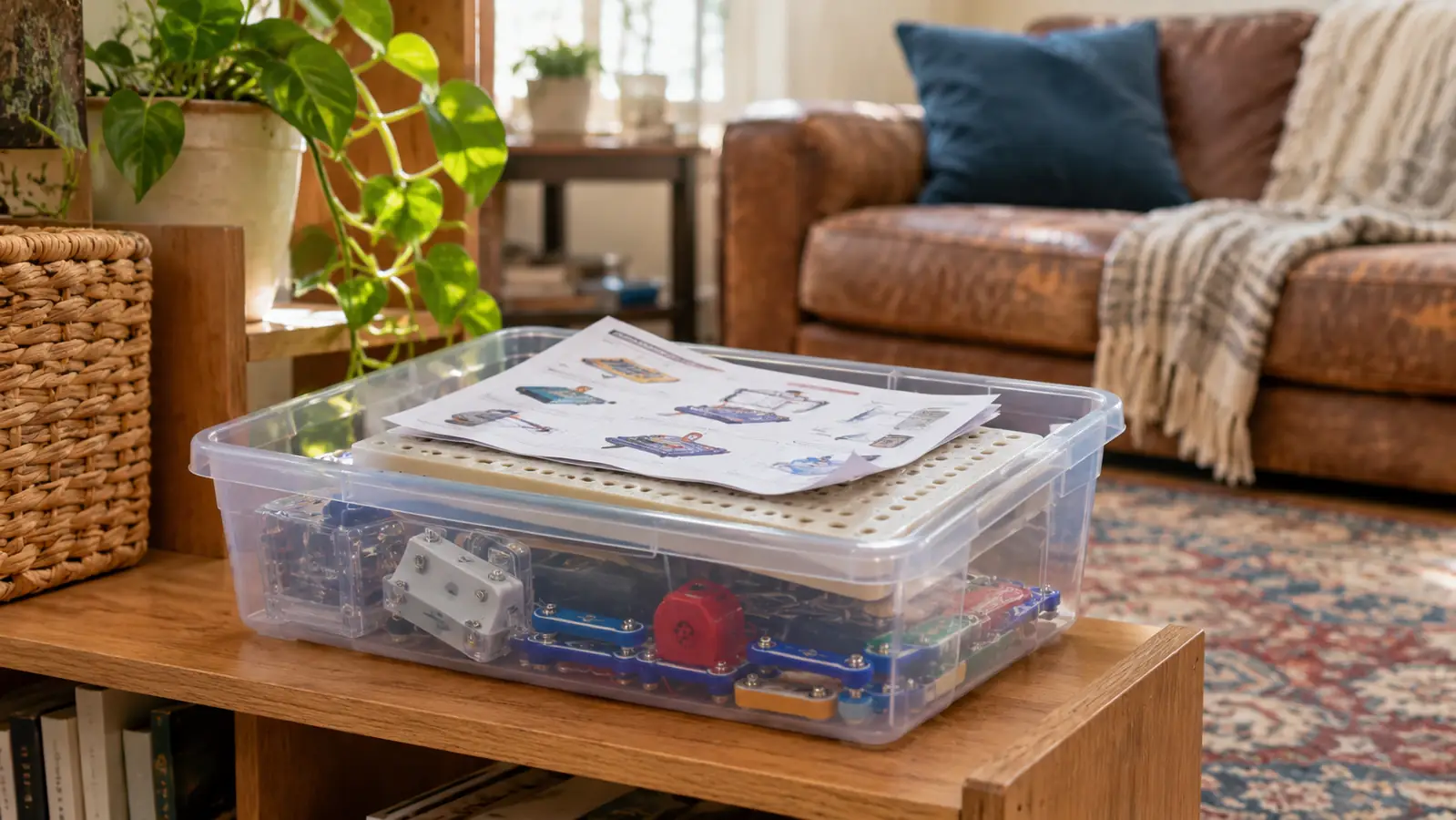
A shallow plastic bin with a lid, on a shelf he can reach, has done more for this kit than anything I bought. The box it comes in is fine for a while and will not survive a determined six year old. Modules and board go in the bin, the manual stays flat on top, and the whole thing is back on the shelf in twenty seconds. If putting it away is a chore, it does not get put away, and then it does not get used.
An adult within arm's reach for the first several sessions is the other thing, and I mean reach, not help. A six year old can do the snaps on his own. What he cannot do yet is stop himself from handing the whole thing over the second it goes wrong. Being there to say take it off and try again, without taking it, is the job.
The last thing is a flat surface with nothing else on it. I clear the mail and the salt and pepper off before we start. It sounds fussy. It is not. Give a boy a table with a week of clutter on it and the kit becomes one more thing to shove aside.
Where It Falls Short
There is no storage case. The pieces are loose in the box and once the box is open they stay loose. That is my biggest complaint and it is why we have the bin. The manual is paper too, so it bends and it gets sat on. Ours has a crease across one page and still works fine.
The bigger limit is that it is a beginner kit and it knows it. Once a kid has worked the projects and wants to build something the manual does not show, this set runs out of room. Wyatt asked me for more parts in week three. That is not really a flaw. It means the kit did its job and he is ready for the next size up.
Who This Fits, and Who It Does Not
It fits a five to nine year old who likes to build and who gets frustrated when instructions are too fiddly. The picture manual is the reason it works for that kid. It also fits a grandparent who does not want to learn electronics first. I do not know how a circuit works. I know how to sit on my hands and ask three questions, and that has been enough.
It does not fit a kid who wants to build a robot on day one, and it will not hold a kid who is used to a screen answering him. Give that one two sessions before you decide. It also is not a babysitter. Leave a six year old alone with loose modules and a paper manual and you will be sorry, and so will the kit.
A month in, this is still the toy on my kitchen table
Snap Circuits Beginner SCB-20 by Elenco. Base board, snap modules, illustrated manual, 21 projects, ages 5 to 9. Start on page one and let him build it four times before you turn the page.
Amazon Check the Snap Circuits Beginner on Amazon →