
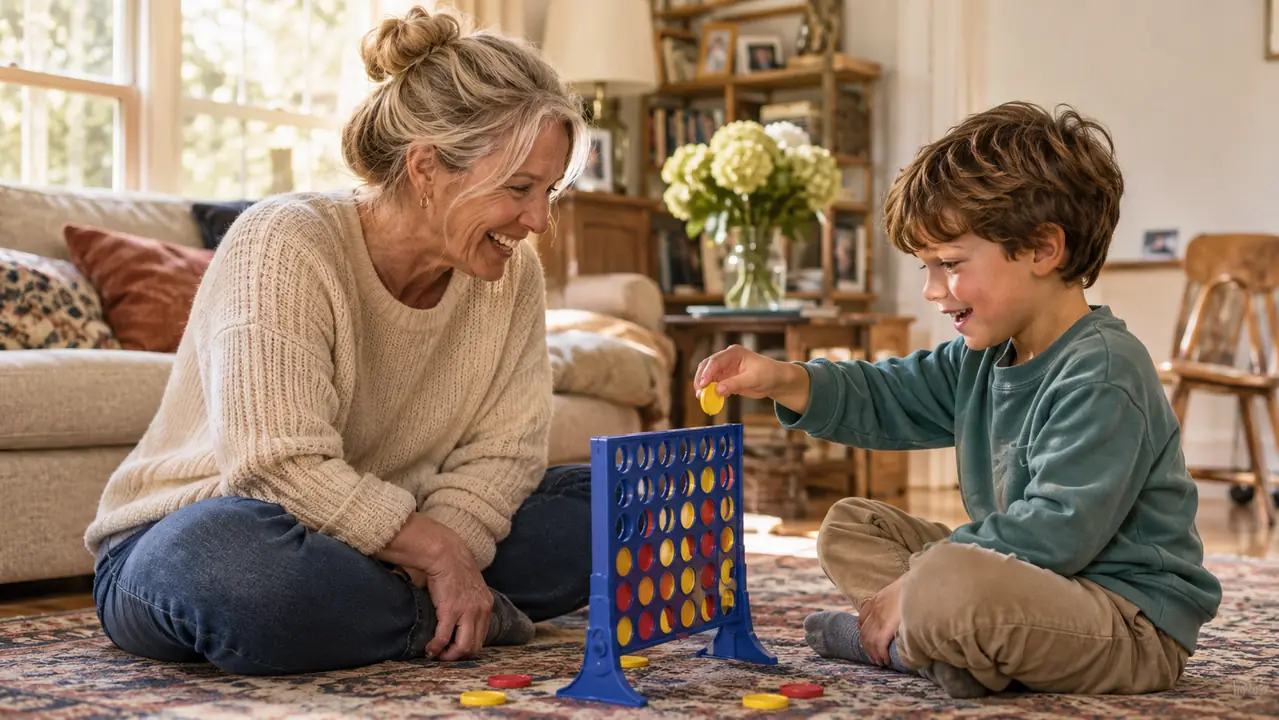
Wyatt is six, and he plays to win. That is not a flaw. That is what a six-year-old is. The trouble shows up about four minutes into any game, when winning stops looking certain and the pieces start looking throwable. We had two games in this house before this one. Both ended the same way, with a small boy under the kitchen table and me putting a lid back on a box. Then the Hasbro Gaming Connect 4 set arrived, and something shifted. Not in one afternoon. But it shifted.
Here is what I learned after a few months of playing it on the living room rug, usually right before supper. The strategy part is teachable to a six-year-old. The sportsmanship part is harder, and it is the part that actually matters. Below is the order I would use if I had to start over from the beginning.
Start with the version of the game that fits in one sentence
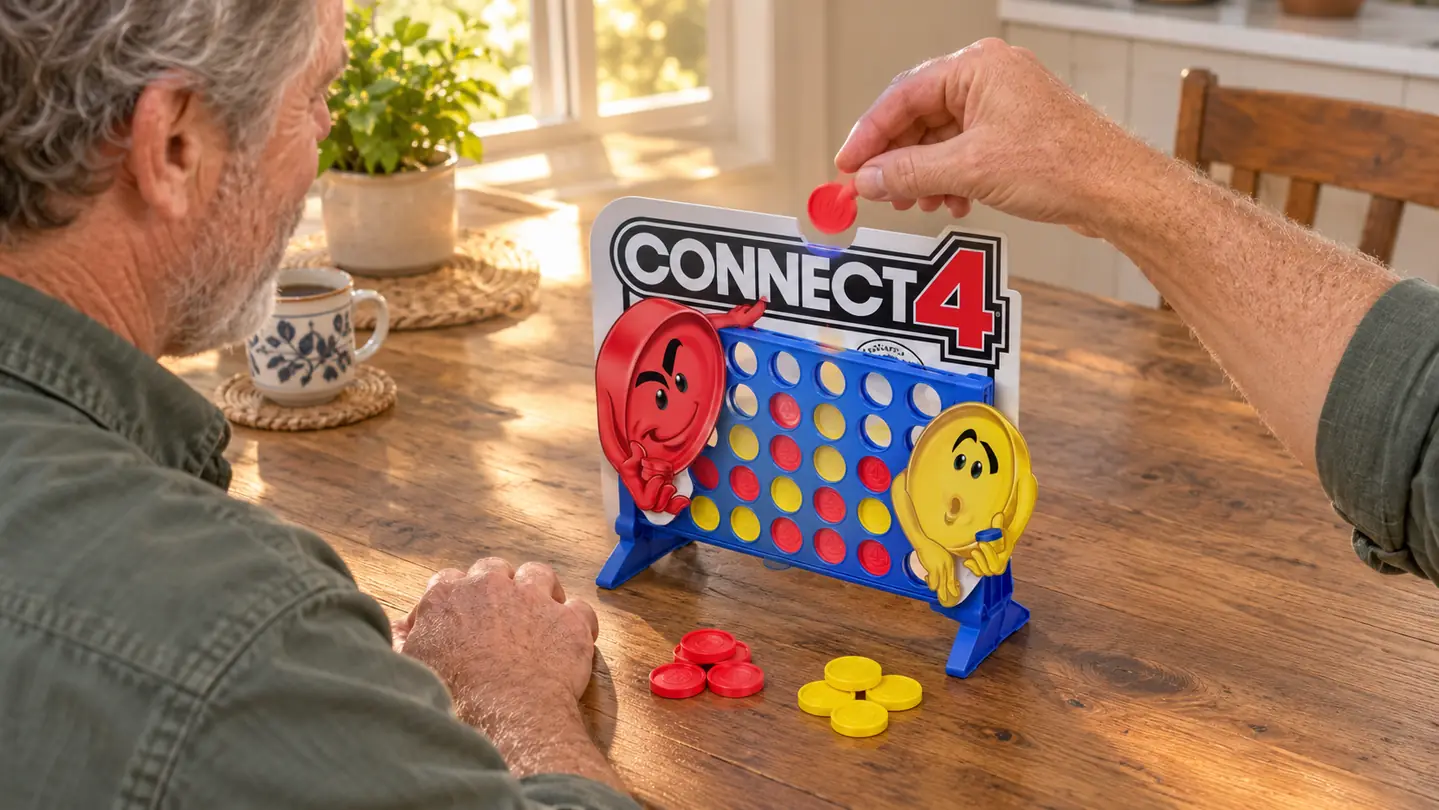
The Hasbro Gaming Connect 4 set is a grid, two feet, a slider bar, 21 red discs, 21 yellow discs, and 4 blue Blocker Discs. Two players, ages six and up, about thirty minutes for a full session. There is no long rulebook to get through before anybody gets to play.
Amazon Check Today's Price on Amazon →Step 1: Play the first five games with the Blocker Discs still in the bag
The set comes with two kinds of pieces, and the first thing I did was keep the four blue Blocker Discs in the box. Not because they are complicated. Because a six-year-old learning a new game can hold about one idea at a time, and the base game is already one idea: take a turn, drop a disc, get four in a row. Before the first game I sat on the rug and fitted the two feet into the bottom of the grid while he watched, then made him push them in himself so he would know how they came apart. The slider bar took him about a minute to work out.
So for the first week we played the plain version. He got a stack of discs, I got a stack, and we took turns dropping them into the grid. The slider bar at the bottom pulls out and the whole board empties at once. He pulled it before we had even sorted the discs, then eleven more times, and I let him, because a boy who is allowed to empty the board is a boy who will keep volunteering to set it up. That first game lasted maybe six minutes and ended with him stacking discs on the rug in a tower instead of playing. I did not correct that. By the fourth day he was dealing out two even piles before I sat down.
Five games in, he understood the loop without being told. Drop, wait, watch, drop again. That is the point where the game stops being a toy and starts being something he can think about.
Step 2: Teach the middle column first
Here is the first real strategy lesson, and it is small enough for a first grader. The middle of the board is better than the edges. A disc in the middle column can be part of a line going left, a line going right, a line going up, and two diagonals. A disc in the far edge column can be part of far fewer.
I did not explain that with words. I set up a board already half full, which is much easier to see than an empty one, and I let him watch me fill the middle while he was busy on the edges. He lost that game, and he knew why, because the line was still sitting there in plain sight when we were done. The next morning he put his first disc in the middle without being told. For two weeks after that I played almost entirely from the middle and let him find the counter to it, so the same lesson repeated eight or nine games in a row without me ever saying the word strategy. Somewhere around the seventh game he started saying the middle one is the best one before I sat down, and he said it like a question, halfway, waiting to be told he was right. I nodded and waited and he took the middle anyway.
Now when we play, I will sometimes ask one question before he drops. Where is the board widest? He answers without looking up. That is the whole lesson, and it took about ten minutes to install.
Step 3: Build the look-before-you-drop habit
This is the step that turns a game of luck into a game of planning, and it is the step most adults skip because they are busy winning. Before he drops a disc, he has to look at my side of the board and find anything of mine that has three in a row. If he finds one, he has to say it out loud before he plays.
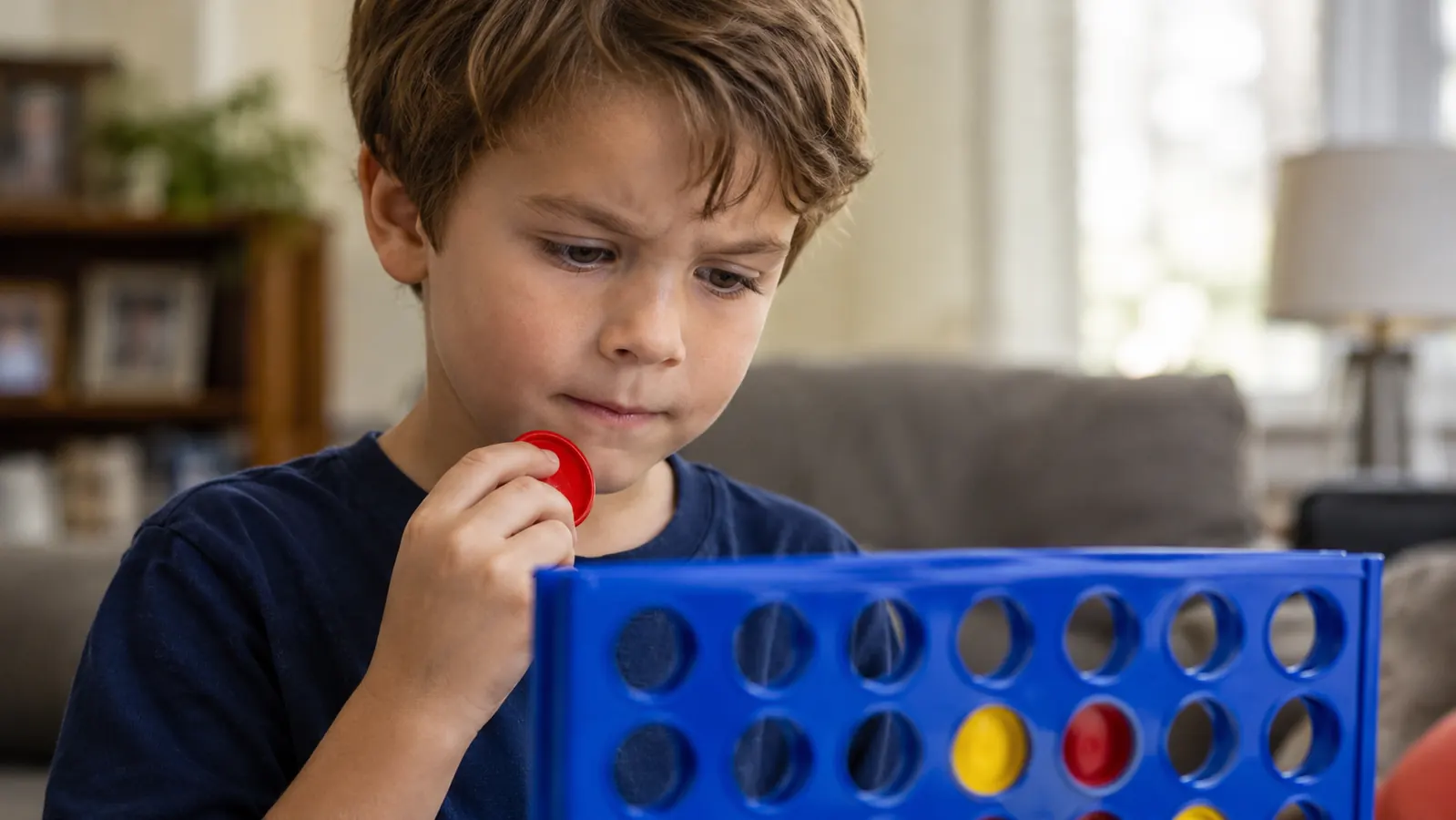
Counting went slowly. He would look at my three and say two, because he was counting the empty space above it, or he would count the same disc twice. So we started touching them. He points at each one and says the number out loud, and the number has to be three before he is allowed to drop. That small rule fixed most of it inside a week. We kept at it for four days straight. By the second day he was counting with a finger on each disc, and by the fourth he was doing it in his head and only saying the number aloud. If I had to keep one piece of this whole routine, it would be that one, because a boy who says three out loud cannot pretend to himself that he did not see it.
I also tried giving him ten seconds to think before each turn, and that backfired badly. A countdown made him rush, and a rushed boy drops whatever is nearest his hand. No clock. Just the question, asked every turn, until he starts asking it himself. The payoff came on a Tuesday, when he dropped a disc without saying anything, then sat back and told me that one stops you. He had seen my three in a row and blocked it on his own. I lost that game, and I was glad to.
The first time he blocked me on purpose, he did not shout. He sat back and said, that one stops you. That was the whole lesson landing.
Step 4: Add the four blue Blocker Discs once the base game gets easy
The Hasbro Gaming Connect 4 set includes 4 blue Blocker Discs, and they change the game more than you would expect. A Blocker Disc goes into a slot and stays there, so nobody can drop into that space, and the discs underneath it sit higher in the grid than they otherwise would. It opens up lines that were closed and closes lines that were open, and a child who has played a hundred plain games will feel that difference in his first turn.
I introduced them the week he started winning the plain game more often than he lost it. That timing matters. If you hand a child a new rule while he is still losing constantly, the new rule feels like one more thing he is bad at. Give it to him when he is confident, and it feels like a promotion.
The first game with the Blocker Discs ran about twice as long as a plain one, because every drop had to be looked at two ways instead of one. He asked whether he could take one back after he had already played it, which is not how any game works, and I said no, and he put his hands in his lap and played on. That is the whole argument for adding the blue discs later rather than sooner. A confident boy can take a no. A frustrated one hears it as one more thing going wrong.
We play with two Blocker Discs each, not four, at least for now. Four is a lot of board to keep track of for a six-year-old, and I would rather he uses two well than four badly.
Step 5: Practice losing on purpose, out loud
I do not let him win every game. I let him win some, and I win some, and I say what I am doing while I do it. When I lose, I say the words out loud. Good game. That was a good block. You got me. He hears me lose without a scene, and he files it away.
I will tell you the worst one, because it is the reason I changed how we do this. In the second month he lost a game where he had three in a row and I blocked him, and he swept the whole grid off the rug with his forearm. Discs went under the couch. He cried. I did not yell and I did not send him to his room. I picked up the discs, said we were done for the day, and the next morning I had the board set up before he came out for breakfast, so the first thing he saw was a fresh game. What I stopped doing was telling him it did not matter. It matters to him. Telling a six-year-old the game does not matter is telling him his feelings are wrong. Now I say the true thing instead. That was a hard loss. Take a breath. Hand me the bar.
The handshake is not optional in this house. Winner offers it first, loser takes it, both look at each other. We started with me holding my hand out and waiting, and now he does it on his own, sometimes before I have finished pulling the slider bar. A handshake is a small thing a six-year-old can actually do, and doing it shortens the sulking by a good margin. The other thing I do is call for a rematch immediately. One loss, one reset, one more game. Ending on a loss is what makes a loss feel enormous. Ending on a fresh board takes the weight out of it. We have played a fourth game more than once because he asked, and I have said no more than once, because a bad night has to end somewhere.
What Else Helps
Play before supper, not after. This is the single biggest change I made. A tired six-year-old at the end of the day has no room for a loss. A six-year-old with a snack in him and something to look forward to afterward can handle one.
Keep the discs in a tub, not loose in the box. The set weighs about sixteen ounces and the pieces scatter. A shallow plastic container on the shelf means setup takes ten seconds instead of two minutes, and a short setup is the difference between playing and not bothering. Ours lives on the low shelf by the television rather than in the closet, because a game a child can reach on his own is a game that gets played on a rainy Tuesday. We lost four discs under the couch in the first month and I found every one of them eventually, but a tub would have saved me the crawling.
Best of three, always. One game is a coin flip and a coin flip can ruin an evening. Three games means the story is about the series, not the single result. And let him teach the game to somebody else once he has it. Explaining a rule to another person is the fastest way to find out whether you actually know it.
Two players, thirty minutes, and nothing to charge or lose
The Hasbro Gaming Connect 4 set is a grid, two feet, a slider bar, 21 red discs, 21 yellow discs, and 4 blue Blocker Discs. It weighs about sixteen ounces, it plays in roughly half an hour, and it resets with one pull of the bar. All four of our good-game handshakes happened over this board.
Amazon Check Today's Price on Amazon →