

I want to start with the thing that annoyed me, because that is probably why you are reading this. About twenty minutes after my grandson Wyatt opened the Snap Circuits Beginner kit, he had already worked one of the modules off the base board and bent the little snap connector doing it. He is six. He is not gentle with anything he owns. The Elenco kit survived it, I pressed the connector flat again, and we carried on. But I sat there on the rug thinking that no product photo on the internet prepares you for the fact that this is a real electronics kit with small parts, not a plastic toy that bounces.
That is the short version of this review. The Snap Circuits Beginner SCB-20 is a genuine first electronics kit for a young child, it does what the box says it does, and it has three or four rough edges the listing quietly leaves out. I have kept ours on the living room rug and on the kitchen table for a good while now, and I have paid far more attention to what Wyatt picks up in week three than to what he did in the first twenty minutes. At seventy-one, that is the only test I still trust.
The Quick Verdict
A real first electronics kit a six-year-old can finish on his own, as long as you accept that the manual is the product and the small parts need a little care.
Amazon Check Today's Price →The Kit He Went Back To Without Being Asked
One base board, a set of snap modules, and an illustrated manual holding twenty-one projects. Elenco builds it for ages five to nine. Check today's price on Amazon before you decide.
Amazon Check Today's Price on Amazon →What Is Actually in the Box
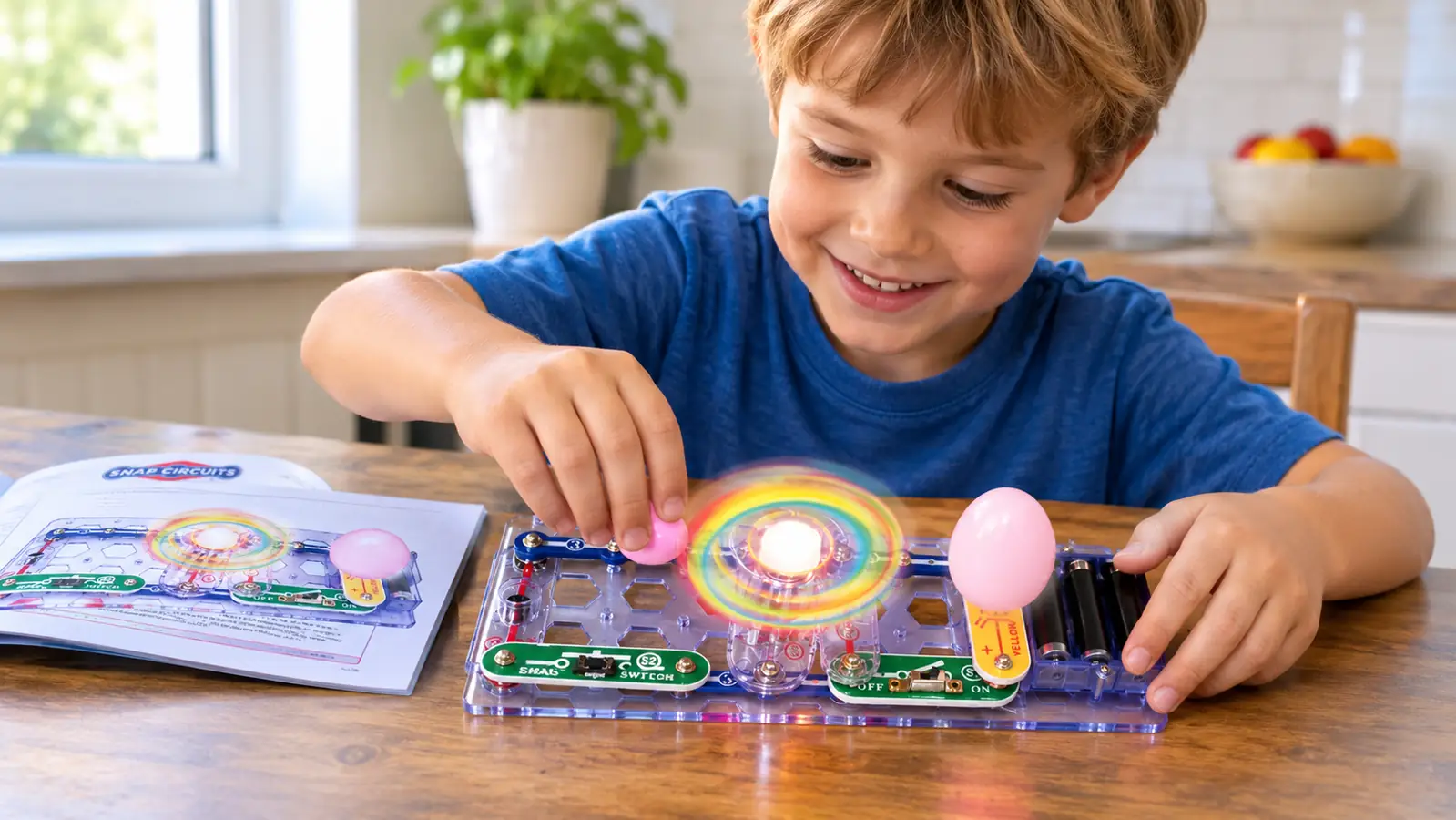
The box holds three things. A snap circuit base board. A set of snap circuit modules. And the illustrated Beginner manual. That is the entire kit, and I mean that as a compliment. There is no screen, no app, nothing that needs my phone or my patience with a download. The listing puts the item weight at 0.23 kg, a bit over half a pound, and that feels right when you lift it. The material is plastic and the manufacturer's recommended age is five to nine years. Wyatt is six, which sits him near the bottom of that range, and that is exactly where I wanted him.
The educational goals Elenco lists are concentration, construction skills, logical thinking, patterning and problem solving. I read that sort of list with a raised eyebrow, the way I read every list printed on a toy box. Then I watched him hunt for one particular module for four solid minutes without looking up, and I stopped arguing with the box. Whether that counts as STEM or just a boy who wants to finish what he started, I could not tell you, and I am not sure the difference matters much at six.
How I Tested It, and What I Ignore
I spent thirty years running a school cafeteria, so I have watched a great many children get handed a great many things. My method has not changed. I put the kit where Wyatt can reach it, I do not prompt him, and I note what he does when no adult is sitting beside him. The first hour tells me nothing. Day three tells me a little. Week three is the number I care about, and it has not failed me yet.
There is a second test I run with a kit like this one, and it matters more than the first. I watch how the boy behaves when a project does not work the first time. Some toys make him sulk and walk away. Some make him lean in. The Snap Circuits kit made him lean in, mostly, with two exceptions I will get to in a minute. That is a real thing, and it is not a thing any product listing can tell you.
Most of our testing happened at the kitchen table, because the rug swallows small parts. I would clear the plates, set the pieces down, and leave him to it while I did the dishes. That gave me a good view without hovering over him. It also gave me the honest picture. The boy goes quiet when he is working, he talks to himself under his breath, and he does not want me watching too closely. That is the state you want a toy to put a child in, and not many of them manage it.
One note on my setup, because it affects everything below. I sat with him for the first two projects. The manual asks a child to match a numbered picture, and I wanted to see whether the numbers made sense to a first grader. After that I moved to the couch and let him work alone. He came to find me three times that first week. Twice it was a real question. The third time he had finished something and wanted a witness. By the second week he had stopped coming to find me at all.
The Manual Is Doing Most of the Work
Here is the part I did not expect. The illustrated manual is not a set of instructions that happens to come with a toy. It is the toy. Each of the twenty-one projects is laid out as a numbered picture, and the child builds by matching module to picture and picture to module. Wyatt cannot really read the project notes yet, and it did not matter. Shape matching was enough. The first time he finished a project without me, he held it over his head like a fish he had caught.
That is also the weakness, and I want to be plain about it. A child who will not sit and match a picture to a picture will get nowhere with this kit. There is no voice telling him what to do, no flashing prompt, no reward at the end of a level. It is a book and a board. My Wyatt likes to finish things, so it worked on him. A boy who expects a toy to entertain him will be bored inside ten minutes, and no amount of grandparent enthusiasm will fix that.
The manual is not instructions that come with a toy. The manual is the toy, and a child who will not sit with it will get nothing out of this kit.
The projects run in order of difficulty and the early ones are short, which is good design. A first grader gets a finished thing in his hands quickly, and that buys you the patience for the longer builds later on. I have watched Wyatt repeat an easy project three times in a row, not because he forgot it but because he likes being right. Elenco built that in on purpose, I think, and it is the reason the kit holds a short attention span long enough to teach it something.
The Part That Takes Getting Used To
Nobody warns you that the snapping itself is a skill. The modules press onto the base board and lift off again, and there is a right way to do it. Pull straight up and everything is fine. Pull at an angle in a hurry and a connector bends. That is what happened to us in the first week. I want to be fair here. The kit is warranted for defects in manufacture, and Elenco stands behind that, but a bent connector from a boy yanking at it is not a defect. It is a six-year-old being a six-year-old.
The fix is simple and it takes about five minutes. I sat down with him once, showed him the straight-up pull, and had him do it four times while I watched. After that we had no more trouble. I would tell any parent to do that on day one rather than wait for the first bent piece and the first argument about it. It is not in the manual, and it probably should be.
Where the Kit Gets Thin
Second complaint, and it is an honest one. Twenty-one projects sounds bigger than it is. The projects are grouped, so several of them are the same idea with one module moved to a different spot on the board. That is fine for teaching, and it is not dishonest, but a parent counting the numbers should count the ideas instead. There are fewer ideas than there are pages, and I would rather you hear that from me than find out on project sixteen.
Third complaint, the loose pieces. There is no case, so the modules end up wherever the child leaves them, and a module left on a rug is a module under a foot. I put ours in a shallow plastic tub that sits on the shelf beside the manual, and that solved it completely. I would not hand this kit to a child who shares a playroom with a toddler, though. Those modules are small, and small things travel.

What the Age Range Really Means
Five to nine is the range on the box, and I think it is close to right, with a caveat at each end. At five, a child can build but will need an adult nearby for the first few projects and will need help keeping the pieces together between sessions. At six, which is where Wyatt sits, he could work alone after two guided projects. At eight or nine, he will move through the manual faster and will start asking the questions the manual does not answer, and that is the point where a larger kit starts to make sense.
The range also tells you something about what this kit is not. It is not a science lesson and it is not a coding toy. It is a box of parts that snap together and produce a finished thing, and the thinking it asks for is the thinking of following a plan and noticing when the plan is wrong. That is worth something on its own. I have watched Wyatt catch his own mistake twice now, and both times he caught it because the picture on the page and the board in front of him did not match.
What Wyatt Stopped Reaching For
By the end of the second week the tub was on the shelf more than it was on the floor. I nearly wrote the whole thing off and started this review as a complaint. Then a rainy Saturday came along, he pulled the tub down himself, rebuilt two projects he had already done, and then started swapping modules from two different pages to see what would happen. That was the moment I decided the kit had earned its shelf space. He had stopped following the manual and started asking it questions.
I cannot promise that for your child. Nobody can, and any review that does is selling you something. What I can tell you is that this is the difference between a toy and a tool, and it is the reason I would choose this kit again over one that lights up and does the thinking for him. Elenco left the screen out, and I am grateful for it.
One more thing worth saying, because it comes up. I have been asked whether a beginner kit is worth having when a bigger kit exists. My answer is that a bigger kit would have been a mistake in this house. Twenty-one projects is about the right size for a boy who is still learning to sit with a task. He finished the manual. He got to the end of something. That is worth more to me than a box with two hundred projects in it that he never opens twice.
What I Liked
- Twenty-one projects laid out so a first grader can match pictures and build alone
- No screen, no app, nothing that needs a phone
- The illustrated manual is genuinely followable at six
- Small enough to sit on a shelf and easy to bring back out
- Covered for defects in manufacture
Where It Falls Short
- Loose modules need a tub or they end up underfoot
- Several projects are variations, so the real count of ideas is lower
- Snap connectors bend if a child pulls at an angle
- A child who wants to be entertained will lose interest fast
- No case in the box
Who This Is For
This is for a child between five and nine who likes to finish things and does not need to be entertained every minute of the day. It is for a parent or grandparent willing to sit through the first two projects and then get out of the way. It is for a house that would rather the boy build something on the rug than watch something on a screen. If that is your house, the Snap Circuits Beginner kit will earn the shelf space it takes up, and it will still be there when he is eight and ready for more.
Who Should Skip It
Skip it if your child is four and still puts small parts in his mouth. Skip it if he wants a toy that does something at him rather than for him. Skip it if you are not going to sit down for the first two projects, because the manual assumes an adult is nearby at the start. Skip it if you want a kit that stores itself, because this one does not. And skip it if your child gets angry at fiddly work and throws things, because the connectors will not take that and neither will your patience.
A First Kit That Asks Something of Him
A book, a board, and twenty-one projects for ages five to nine. No screen and no app. Check today's price on Amazon and see whether it fits the child in your house.
Amazon Check Today's Price on Amazon →